



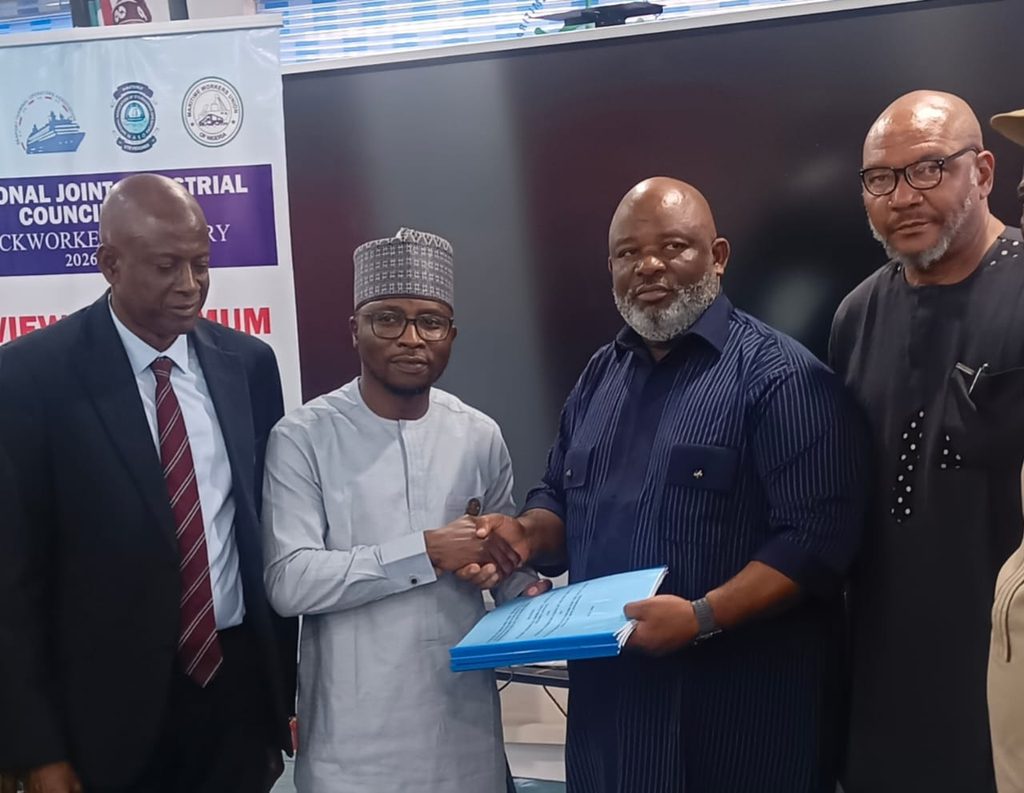
The Nigerian Maritime Administration and Safety Agency (NIMASA) and the Maritime Workers’ Union of Nigeria (MWUN) have begun negotiations to harmonise wages, improve working conditions and strengthen welfare provisions for dockworkers under a proposed minimum standards agreement covering 2026–2028.
The review commenced at the reconvened National Joint Industrial Council (NJIC) meeting facilitated by NIMASA, where employers, labour unions and other industry stakeholders presented their proposals for consideration.
The submissions address key areas, including wages, workers’ welfare, occupational safety and health, pension provisions, working conditions, provision of protective equipment and skills development.
The proposals will serve as the basis for further consultations aimed at establishing an improved and harmonised framework for the dock labour industry.
Speaking at the meeting, the NJIC Chairman and Executive Director, Maritime Labour and Cabotage Services, NIMASA, Mr Jibril Abba, said the welfare, safety and fair treatment of dockworkers were essential to efficient port operations and the competitiveness of Nigeria’s maritime industry.
Abba described dockworkers as indispensable players in the maritime value chain, stressing that fair remuneration, decent working conditions, adequate safety provisions and opportunities for professional development were critical to the efficiency and sustainability of the nation’s ports.
He explained that the review was necessary to address existing disparities in wages and employment conditions, strengthen compliance with industry standards and accommodate changing operational realities arising from technological advancements and evolving port activities.
The NIMASA executive director urged all parties to approach the negotiations with a shared commitment to fairness, mutual understanding and industrial harmony.
In his remarks, the President-General of MWUN, Comrade Francis Bunu, commended NIMASA for providing a platform for sustained engagement between workers and employers.
He called for the speedy conclusion of the review, emphasising that the outcome must translate into measurable improvements in the welfare and working conditions of dockworkers.
According to Bunu, the agreement should go beyond formal commitments on paper to deliver better welfare packages, improved working conditions and sustained industrial peace across the nation’s ports.
The National Joint Industrial Council provides a structured platform for government, employers and organised labour to negotiate minimum conditions of service, promote decent work and strengthen industrial relations within the dock labour sector.
NIMASA reaffirmed its commitment to examining the submissions and sustaining consultations with stakeholders towards securing a mutually acceptable framework that balances workers’ welfare with the operational realities of the maritime industry.
Organisations represented at the meeting included the Seaport Terminal Operators of Nigeria (STOAN), Oil Producers Trade Section (OPTS), Association of Bonded Terminals Operations of Nigeria (ABTON), National Association of Stevedoring Operators (NASO) and MWUN.