



Ibom Air has implemented the latest safety directive issued by the Nigerian Civil Aviation Authority (NCAA) on the carriage and storage of power banks onboard commercial flights, reinforcing its commitment to passenger and crew safety.
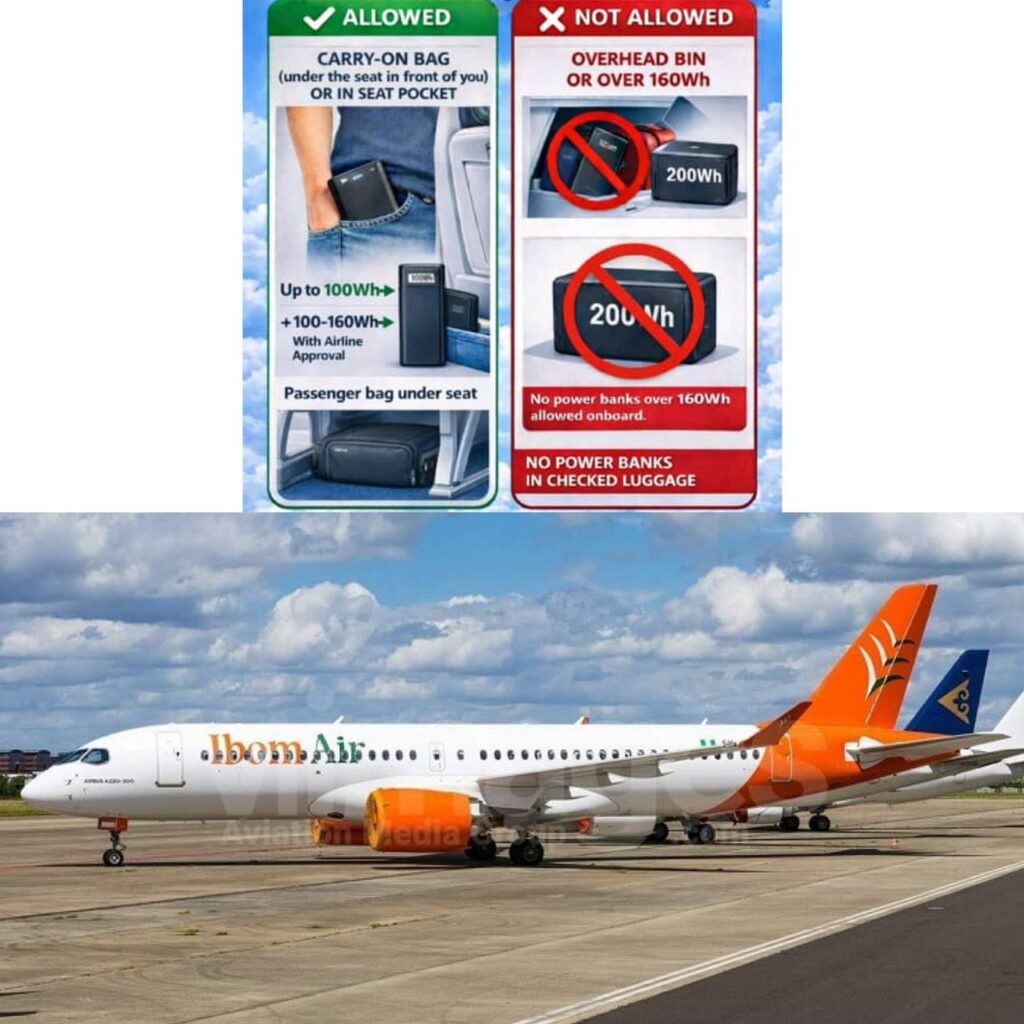
The directive announced in a statement from the airline, aligned with global aviation safety standards, prohibits passengers from placing power banks in overhead bins during flights. Instead, all power banks must be kept in the cabin and stored under the seat in front, inside the seat pocket, or in a carry-on bag that remains easily accessible at all times. The long-standing ban on placing power banks in checked baggage remains unchanged.
According to the NCAA, the measure is designed to ensure rapid response in the event of overheating or fire. “Power banks must not be placed in the overhead luggage bins during flight. They must be carried in the cabin and stored either under the seat in front, in the seat pocket, or in a carry-on bag that remains accessible to the passenger at all times”, the directive states.
Under the new guidelines, power banks with a capacity of up to 100 watt-hours (Wh) are permitted without restriction. Devices rated between 100Wh and 160Wh require prior airline approval before travel, while power banks exceeding 160Wh are strictly prohibited onboard aircraft. Passengers are advised to verify the watt-hour rating of their devices, typically indicated on the battery casing.
The updated directive follows a number of global incidents involving lithium-ion battery fires. Aviation safety experts warn that lithium batteries can experience “thermal runaway” — a rapid overheating process that can trigger intense and difficult-to-control fires, particularly at cruising altitudes where emergency response options are limited. Storing such devices in overhead compartments may delay detection and increase the risk of fire spread before cabin crew can intervene.
Ibom Air reaffirmed that safety remains one of its core operational values and pledged continued collaboration with regulatory authorities to ensure full compliance with all aviation safety standards.
Passengers are encouraged to consult the airline’s website for detailed information on permitted items and travel guidelines ahead of their flights.