
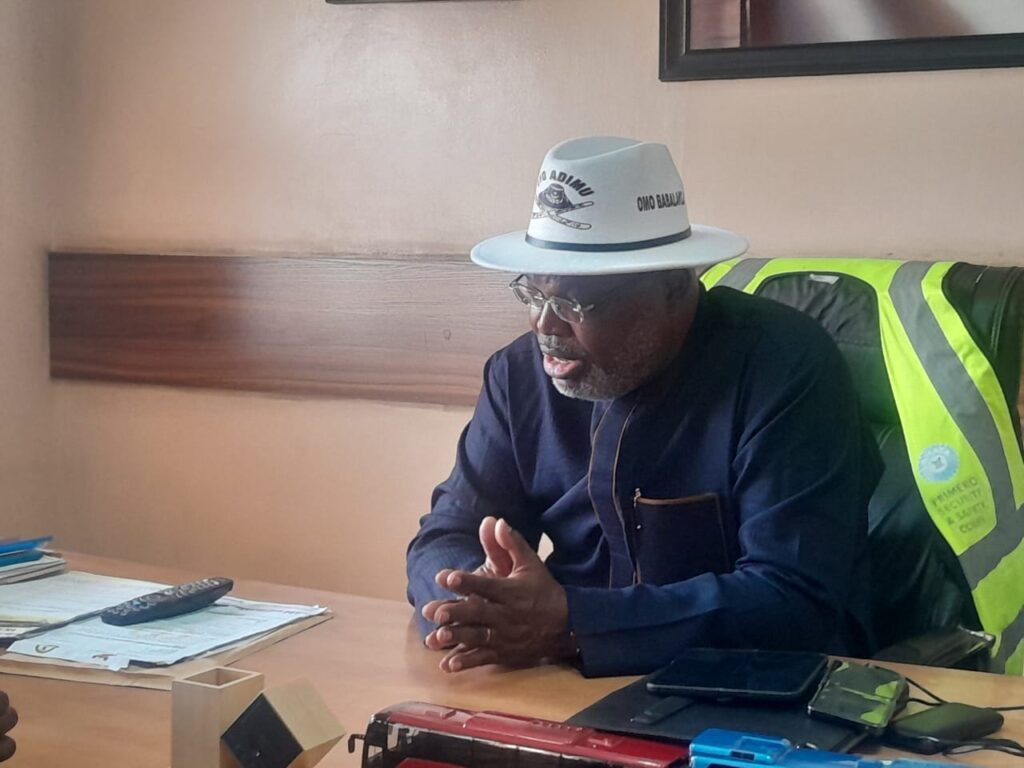
The Managing Director of Primero Transport Services, Afolabi Tinubu, has delivered a frank and deeply insightful account of the realities behind operating Lagos’ Bus Rapid Transit (BRT) system, stressing that public transportation in Nigeria cannot survive without deliberate government subsidies.
In this exclusive, full-length interview with JustNet News, Tinubu speaks extensively on the economic shocks that have shaped the company’s journey, including the impact of foreign exchange volatility, surging diesel prices, and rising maintenance costs. He also addressed public criticism, explains why many buses remain grounded, and revealed the difficult operational choices required to keep the system running.
From innovation milestones such as e-ticketing and onboard Wi-Fi to plans for Compressed Natural Gas (CNG) buses and intelligent transport systems (ITS), Tinubu laid bare both the progress made and the urgent reforms needed to sustain and transform urban mobility in Lagos.
Excerpts
Introduction and Overview of Primero Transport Services
Can we meet you, sir?
My name is Afolabi Tinubu. I am the Managing Director of Primero Transport Services, the operator of the BRT buses from Ikorodu to TBS and also from Oshodi to Abule-Egba and TBS.
It has been a remarkable 10 years for Primero buses in Lagos. What have been the highlights of your operations and how have you contributed to improving transportation here in Lagos?
Well, thank you very much. We have contributed significantly to transportation in Lagos. We have been in operation for 10 years, and the last 10 years have been very challenging and also very uplifting because we have been able to help Lagosians, move them from point A to point B in a safe, affordable way.
And the highlights have been many, and not just this year. In the last 10 years, we have introduced so many new concepts into public transportation systems in Lagos. And I can mention about two or three. One of them, we were the first to do electronic ticketing. We were the first to put Wi-Fi in all our buses. You know, we were the first to put a charging point in the bus so that you can charge your phones and all that kind of stuff. And it’s been so rewarding because I believe Lagosians have really enjoyed our services.
Challenges Faced and Overcoming Them
As the Managing Director, what challenges have you faced, and how have you overcome them?
Challenges? That’s an understatement. Since we started, there have been different challenges, in fact, almost every day there is a new challenge.
And how have we overcome them? It’s been tough and rough the last 10 years. In fact, I keep telling people that if I knew what I know now, I probably wouldn’t have encouraged my investors to make the investment that they did 12 years ago when we started.
And the biggest challenge we faced was the Naira because we bought the buses from China, and when we bought them, Naira was about 160 to $1. And if you remember 2015, it went all the way to about 500 and something before it came down, and now it’s about 1,000 plus. So, what that did was that the debt that we took to buy the buses more than doubled.
And because people ask me, “Why didn’t you hedge?” But Nigerian banks don’t hedge. I believe only one bank will hedge for you in Nigeria, and even they will be asking for the premium they’re asking for to hedge for one year is very high. So, it’s tough to hedge in Nigeria, so you have to take the loan open, naked, and the loan doubled. And it’s been a struggle since then. Also, because of Naira, all the parts that we use have tripled in prices, some of them more than triple in prices since we started.
So, it’s really been very, very challenging for the last 10 years. You know, at this point, I’ll have to say kudos to our bank, Sterling Bank, because especially their MD, Abubakar Suleiman, they stood with us through thick and thin, and they’re still with us. They’re the ones that have kept us alive since that time because if not, Primero would not even be where we are today. Challenges; there are so many, but I’ve just mentioned two of the major ones.
Handling Criticism and Feedback
Primero is offering fantastic services to the public, to Lagosians, but there are criticisms about your services and all that. So how do you respond to them?
Criticism is part of the business, and I’m a big boy, so I take it as it comes. And the irony is that in this business, you cannot but be criticised. And I’ll give you an example: if you move one million people, okay, you move 950,000 of them on time without any issues. Those 950,000 will never say anything. But you see that 50,000 that you did not move on time, oh God, they’ll go online, they’ll say “you don’t know what you’re doing.”
Well, criticism also puts us on our toes and it makes us better. I’m not adverse to people criticising me. All I want is for you to be objective. But that people criticise me, that’s part of the business, and that’s why I sit where I’m sitting. If you don’t want to be criticised, then stay at your house. So, criticism doesn’t bother me at all. I just take it in my stride, I listen, and look, nobody has a monopoly of wisdom and you never know who will proffer a solution to your problems. So, when people criticise you, you should listen, at least look at it. Some people criticise just for the fun of it, just for the sake of criticising you – that’s fine. But some of them actually want you to do a better job, so you should not run away from criticism, it’s part of the job.
Expansion Beyond Lagos and the Importance of Subsidies
With what you have seen in the last 10 years, do you think of expanding beyond Lagos, Primero offering services beyond Lagos State?
I just told you that if I knew what I know now, we would not have made that investment. And look, public transport is needed. It’s needed and it’s very, very important. And it’s the backbone of every economy because people need to move from point A to point B. But all over the world, public transport is heavily subsidised because if you try to charge the full price, it will not be affordable. And if you take the affordability out of it, then it’s no longer public transport, then it becomes an elitist mode of transportation like Uber or something like that.
But the political will has to be there; Federal, State, and Local Government. I know subsidy in the Nigerian context connotes a very bad concept because of what has happened with our history with oil subsidy and all that kind of stuff. But I keep telling people that I don’t know where we read our own economics because all over the world, public transport is what is subsidised because that’s what the masses use. But we don’t subsidise that; instead, we’re subsidising petrol that people tax all over the world for the government to raise money. In Europe, almost between 40 to 70 per cent, depending on which country you are, of what you pay at the pump is tax. In America, it’s about 30 per cent. So, governments all over the world taxes petrol to discourage people from using their cars and to raise revenue. That’s the one we are subsidising. The public transport that the rest of the world is subsidising, that’s the one we’re saying we don’t want to subsidise. We cannot run away from this issue. If we want a world-class service, it has to be paid for. The question is who pays for it.
And the last 10 years has taught me that the masses are already squeezed so much that even if you give me a 100 per cent increase in my transport fare right now, it would not solve my problem because when we started, diesel was about N120 to N130 a litre. We’re now buying the diesel at N1,000 plus a litre now. Tires that we were buying at about 60,000 per one, we’re now buying about 300,000 to 400,000 per one. So, all the things that we use on the buses have gone up by 300, 400, some of them 1,000 per cent.
I cannot increase my fare by 100 per cent. In fact, the increase that we’ve gotten since we started up till now is not up to 100 per cent because I remember when we started, TBS I think was N400 or N500, it’s now N800. But my operation cost, I just mentioned diesel, and diesel is our number one cost, 80 per cent of our revenue goes to diesel. We started at about N120 a litre, it’s now N1,000 plus and it went to about N1,500 at one time before it came down now. So, the political will has to be there – Federal, State, and Local Government.
The government doesn’t care whether the Federal, State, or even Local Government cannot provide enough buses, ferries, and trains for mass transit all over the country. So, they need the private sector to step in to help. But for the private sector to step in, there must be a modicum of profit for them. If there’s no profit for them, they’re not going to step in. And especially Lagos needs it, maybe Abuja to some extent, Kano – some of the states with big populations need public transportation. But if we do not do the needful, it’s not going to happen. I keep saying that in this country we need to make a decision: do we want a world-class service or do we want an Okada mode of public transport? It’s our decision. But if we want a world-class service, it has to be paid for. The question is who pays for it? But you do not transfer the social responsibility of a state to a private company. You do not, and that’s what’s happening now.
Improving the Customer Experience and Maintenance
Primero bus has been at the forefront of innovation in the transportation sector. What is next on the horizon for the company in terms of technology and customer experience?
Look, on the customer experience, people tell me my buses are lying down at the terminals; in fact, I used to think like that before I became the MD of Primero, that we do not have a maintenance culture in Nigeria. But the question is not maintenance culture, the question is Naira and kobo. If the company is not making money to cover its cost of operations, then it can’t buy parts to fix the buses.
I have buses right now that if I have money, I can fix and put on the road. But if I don’t have the money to buy the parts, I can’t fix them. Everybody calls me and says, “Afolabi, we need more buses, we need this, we need that.” Nobody asks me, “how have you managed to keep it going for the last 10 years?”
We know when the buses are due for services, we know how to fix the buses, we’ve sent our people to China, they’ve been trained, they’re well-trained. There’s nothing on the buses we cannot fix. But you have to buy the parts. And if you don’t have the money to buy the parts, what can you do?
At our 10th anniversary, I was talking to my staff and the dignitaries that were there and I told them every month I have to make evil decisions – evil decisions because I have to decide on the little money that has come in, how are we going to divide it up. I have to decide: do we buy diesel, do we buy parts, do we pay our staff, do we pay our vendors that we owe money to? So, every month I have to make evil decisions. But I have to make the decisions, I have to prioritise.
Not that we cannot put more buses on the road. I know people are suffering, I know they need more buses on the road. We have the buses, but we don’t have the money to buy the parts to fix them and put them back on the road. And that is God’s honest truth.
The buses being parked in my yard are not making any money, I’m owing on them, they’re costing me money. So, it’s not my choice. I don’t know why people would think any businessman would park buses in his yard that is costing him money, that is paying interest, that is paying the bank on, and be happy. It’s when they’re on the road and they carry you that I make money, that I can pay the banks. So, for the buses to stay in my yard is not good for me financially.
What’s in my best interest is to find a way to put all the buses on the road so that, that way you people can use it, it can move people faster. But when I don’t have the money to buy the parts, to buy the tires, to pay for fuel, there’s nothing I can do. And that’s why I keep saying we need to make a decision in this country: what mode of transportation do we want?
People like to buy new things in this country – shiny things but then two years, three years, four years down the road they’re all gone. We need to come up with a business model that is sustainable, that 10 years from now, 20 years from now, 50 years from now when we’re all gone, the business is still running.
Partnership with Lagos State and Conversion to CNG
But Primero is in partnership with Lagos State, so what’s that partnership like? Because I thought Lagos State brings in a kind of a subvention to help your operations.
As of this moment, Lagos State does not have any shares in Primero Transport Services. Primero is 100 per cent owned by Primero Transport Services Ltd as of this moment, it may change, but as of this moment, Lagos State does not have any shares in Primero Transport Services. And it’s a Public Private Partnership (PPP) arrangement. We bought the buses, we paid 100% for the buses, and Lagos State provided the BRT lane and the depot and infrastructure for us to be able to run the service.
At your 10th anniversary, you announced that you’ll be rolling in 100 CNG buses. Do you think this will bring any improvement?
Well, it should because we’re talking to the federal government. Look, at this stage I have to thank the federal government because the federal government is working with us trying to convert at least 100 of our buses from diesel engines to CNG. And what we’re doing is we’re bringing brand new engines in because the engines are old, so we’re not converting those because you don’t want to convert an 11- to 12-year-old engine. So, we took out the diesel engine and we put a brand new CNG engine in.
And the federal government has been gracious enough to work with us and to partner us on that. So, we’re almost at the end of that, so very soon you’ll start seeing CNG buses from Primero. And that should help because they’re brand-new engines, so that means there’ll be more buses on the road and also the cost of operation will be reduced because CNG is a lot cheaper than diesel. But the difference is not going to solve the problem, it will ameliorate it, it will make it a bit better and easier, but it won’t solve it completely. But every little thing helps and every help you can get, you have to be grateful for. So, I really thank the federal government for this because they have gone out of their way to make sure this process works.
Look, I’ll also give kudos to the Lagos State government. They have in their own ways tried to help us and they have really stood with us through thick and thin. They can do more, but I thank them.
Closing Message to Customers and Stakeholders
What message do you have for your customers and stakeholders for this 2026?
Well, look, the first thing I will say to my customers is thank you very much for your steadfastness, for your patience, and for your endurance. Like I said, we’re working with the federal government to convert 100 buses, so that means another 100 buses will join the fleet out of the ones that are down. And once they join it, the numbers of buses will go up, so they will see a dramatic improvement certainly in this new year.
Looking back on 2025, what are you most proud of and what are your goals for this year?
Looking back on 2025, it has been a very, very challenging year. But we have persevered, we’ve endured, and we’re still here. I’m proud of my staff because I was even shocked during the 10th anniversary last week, over 90 of them have been with us since inception or at least eight years or more. And for them to have stayed all that long through all the things that we’ve gone through, I have to give it to them and I really thank them. And also, I’ve been proud of our customers because they’ve endured and they’ve stayed with us through thick and thin. So, what I’m proud of are my staff and my commuters.
Looking at your experience in transportation, what would be your advice to young entrepreneurs that want to make a difference in the transport sector?
Don’t be afraid. It’s not a get-rich-quick sector. It requires a lot of hard work, a lot of perseverance, and a lot of criticism. But if you can stick through it, eventually you’ll succeed.
What drives your passion for transportation? Is it because you’re an economist and you know that transport is strategic to the economy?
No, no, no. Actually, I got into transport in a back-end way. It wasn’t that I planned to go into transport because my background, like you already said, I read Economics and I was in mortgage banking when I was in America. So, when I came to Nigeria, LAMATA put up an RFP in the newspaper and a couple of my partners read it and we all got together and we liked what we saw, we approached them, they gave us some numbers, and the numbers looked very good. So, we thought, “okay, we can make a killing here,” and that was how we got into investing. And I keep telling people, when I went in, I was a businessman, but now I’m a transporter. Now I know. When we went in about 11 years, 12 years ago when we started, I wasn’t a transporter, I was just a businessman looking for an opportunity, looking for a way to make a little money but now I can call myself a transporter because the last 10 years has taught me a lot.
How do you see the transportation landscape in Lagos evolving and how is Primero positioning itself to stay ahead?
Look, I know we’re going to an election year next year and this administration’s term will finish probably by early 2027. The public transport in Lagos State will depend on who becomes the next governor. Because the next governor, just like the team of Governor Sanwo-Olu, has paid attention, the present governor has paid attention to public transportation. The next governor also must pay attention to public transportation. The next governor has to build on the present governor’s achievement and take it to a higher level.
Primarily, with regards to PRIMERO, we will still be here. 10 years from now, we will still be here. Like people say, we are the flagship of public transport in Lagos State and we will still do everything possible to make sure we’re the flagship of public transportation in Lagos State. The last 10 years has taught us a lot, we’ve learned a lot, we’ve been bumped, but we are very resilient and we will continue to provide public transportation for Lagosians.
Look, I keep telling people, I’m a Lagosian, and I love everything about Lagos. I was born, bred, and raised in Lagos. Anything that will push Lagos State forward, I’m all for it. And I will do whatever is in my power to make Lagos State the envy of the world.
You have been at the forefront of introducing technologies, what other technology do you intend to introduce? Especially with the CNG brand new vehicles that are coming?
Our emphasis going forward is actually going to be on intelligent transportation systems. Because look, at this juncture, I’ll say kudos to the Lagos State Government again, I’ll say kudos to LAMATA. They’ve introduced a system whereby when you get to your station, you know when the next bus is coming and it’s real life. And also, we created an app that from your house, you can know what time the next bus will arrive at your station and all that kind of stuff. We want to go back to that.
But my biggest problem, and Lagos State’s biggest problem, and LAMATA’s biggest problem, is vandalism. Because people go and cut the cables, the armored cables. They cut them. And I remember in Ikorodu, the armored cable was cut and I went to the MD of LAMATA then and I spoke to him, I begged him, and even he went to the governor, and they put the cable back on. But within two, three months again, they went and cut the cable again. So, it’s difficult for me to go and ask for them to come and put the cable back on again. Look at all the covers on our corridor, the manhole covers. They’ve all been removed.
We keep criticising the government, but what we, the populace, what we are doing also is not helping. We have big plans for the Intelligent Transportation System (ITS) to make sure that before you leave your house, you know when the bus will be there and when the next bus will be there at so-so time, and all that kind of stuff. That’s what we want to focus on: technology. Technology to make sure the buses are at the right place at the right time and we know when they’re supposed to get there.
But when people keep sabotaging it, it makes it difficult. It makes it difficult for the government to keep on spending money. The government has other priorities. They cannot keep on spending money fixing things that they’ve already done.
So, we, and that includes me, we all have to be responsible and like they said, “when you see something, you say something.” Somebody must see them when they’re cutting the cables. Somebody must have seen them when they’re removing the LEDs that were put in the stations to advise people. Somebody must notice.
So yes, our focus is technology to make sure technology makes commuters’ experience better and easier. But I’m using this opportunity to beg people, as the government provides this infrastructure, we cannot keep damaging it. We cannot keep stealing them. We cannot.