



The Minister of Marine and Blue Economy, Dr. Adegboyega Oyetola, has faulted the placement of the 2026 budget of the Council for the Regulation of Freight Forwarding in Nigeria (CRFFN) under the Federal Ministry of Transportation (FMT), instead of the Ministry of Marine and Blue Economy, saying the misalignment weakens policy coherence and oversight across the maritime logistics value chain.
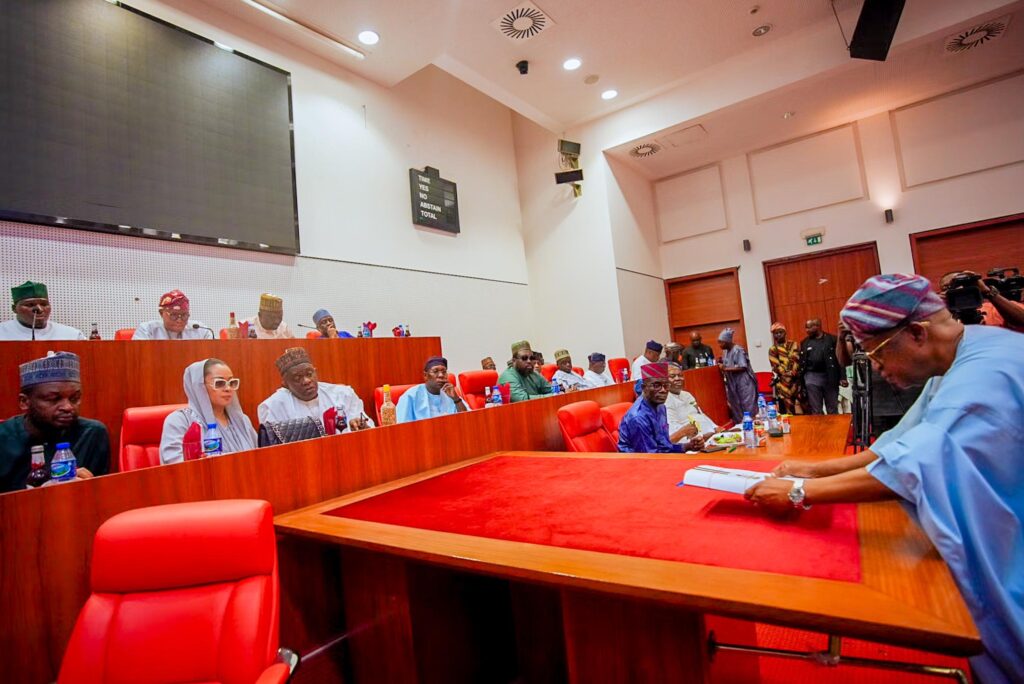
Oyetola spoke on Tuesday while presenting a ₦10.49 billion budget proposal for the Federal Ministry of Marine and Blue Economy for the 2026 fiscal year to the National Assembly (NASS).
He also warned that the allocation is grossly inadequate to deliver the reforms and investments required to drive Nigeria’s trade, transport efficiency and food security.
Defending the Ministry’s budget before a joint sitting of the Senate Committee on Marine Transport and House of Representatives Committees on Ports and Harbours; Maritime Safety, Education and Administration; Shipping Services; Inland Waterways; and Ocean and Fisheries, he explained that the proposal totals ₦10,499,984,667.10, made up of ₦8.24 billion for capital expenditure, ₦453.86 million for overheads and ₦1.81 billion for personnel costs.
The Minister noted that the figure would merely sustain basic operations rather than achieve meaningful sectoral growth.
According to the Minister, the Ministry supervises critical and interconnected subsectors — ports, shipping, inland waterways, fisheries and aquaculture which account for over 90 per cent of Nigeria’s international trade by volume, national food and nutrition security, and overall economic competitiveness.
He said agencies such as the Nigerian Ports Authority (NPA), Nigerian Maritime Administration and Safety Agency (NIMASA) and Nigerian Shippers’ Council (NSC) were largely self-funding and remitted substantially to the Consolidated Revenue Fund, but their capacity had been weakened by excessive deductions at source by the Office of the Accountant General of the Federation.
“These deductions have reduced liquidity and operational flexibility of agencies responsible for maritime safety, port efficiency and regulatory oversight”, Oyetola said, adding that the outcome includes port congestion, rising logistics costs, delayed cargo movement, revenue leakages and inflationary pressure.
The Minister stressed that what appears as an accounting practice has become a national economic issue.
On inland waterways, Oyetola called for stronger funding to curb accidents and loss of lives, noting that water transport is globally cheaper and more efficient than road haulage. He observed that Nigeria currently moves over 80 per cent of freight by road, accelerating infrastructure damage and inflating the cost of goods, while efficient waterways could ease road pressure and reduce logistics expenses.
On fisheries and aquaculture, he said Nigeria’s annual fish demand exceeds 3.6 million metric tonnes against domestic production of about 1.4 million metric tonnes, forcing imports valued at over $1 billion yearly. He added that post-harvest losses of up to 30 per cent further shrink supply, even as fish remains one of the most affordable protein sources for households.
Oyetola assured lawmakers that the Ministry is intensifying efforts to boost local production and cut dependence on imports.
He disclosed that in 2025, the Ministry’s revised capital budget of ₦3.53 billion received only ₦202.47 million in actual cash release, representing about 1.7 per cent, while overhead releases stood at 35 per cent.
According to him, engagements are ongoing with the Ministry of Budget and Economic Planning to close funding gaps in line with the federal government’s diversification drive through the marine and blue economy.
Chairman of the Senate Committee on Marine Transport, Senator Wasiu Eshilokun, assured that the National Assembly would scrutinise the proposal, stressing the strategic role of the marine and blue economy in national development and economic resilience.