



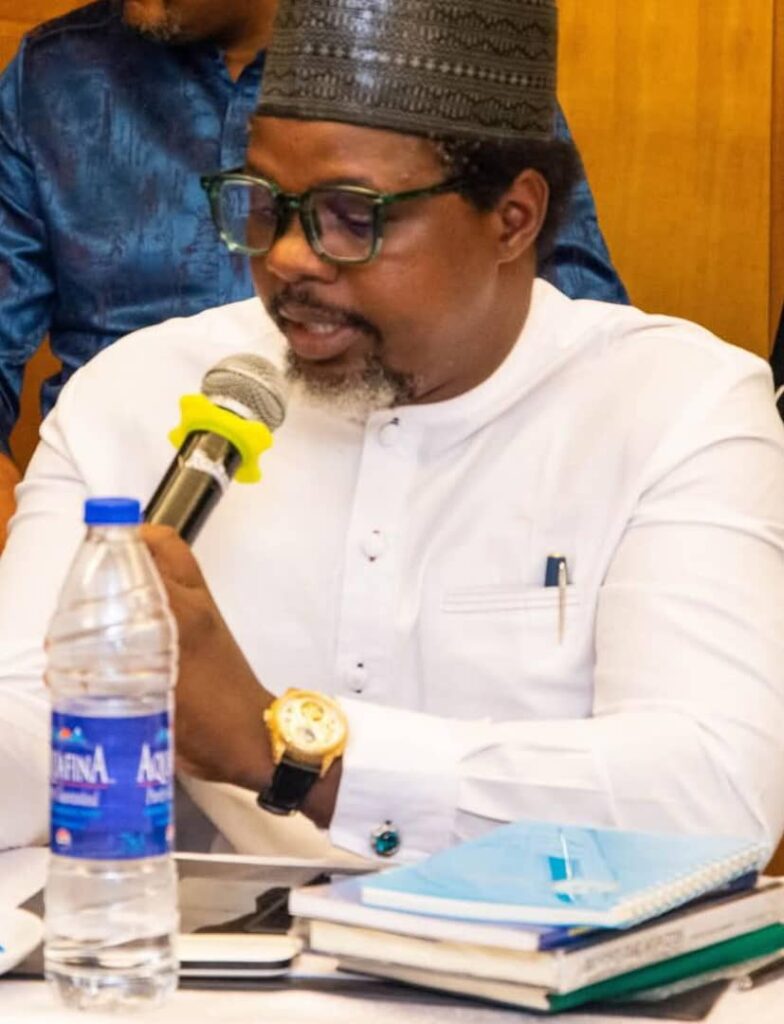
A logistics expert and Managing Principal of AZ Logistics, Dr. Azeez Mustapha, has called on the next Federal Government to make Nigeria’s maritime and blue economy a central pillar of its economic agenda from 2027.
Mustapha said Nigeria had the coastline, waterways, ports, human capital and strategic location required to become a major maritime and logistics hub, but warned that the country had yet to develop an integrated strategy capable of converting those assets into sustained economic prosperity.
He made the call while delivering a keynote address titled “Setting the 2027 Presidential Agenda Towards Unlocking Nigeria’s Maritime and Blue Economy Potential”, where he outlined a practical framework for transforming the sector beyond 2027.
Nigeria’s Problem Is Not Lack of Maritime Potential
According to Mustapha, Nigeria’s challenge is not a lack of maritime resources but the failure to consistently translate its enormous potential into jobs, investment, industrial growth and lower logistics costs.
“Natural endowments become economic advantages only when supported by sound policies, efficient institutions, modern infrastructure, skilled people and strong partnerships between government and the private sector”, he said.
Mustapha, who said he had spent more than two decades engaging with Nigeria’s logistics and maritime ecosystem, described the creation of the Federal Ministry of Marine and Blue Economy as an important shift in national thinking.
He, however, stressed that the establishment of the ministry must be followed by measurable implementation, clear responsibilities and sustained funding if the blue economy is to move beyond policy declarations.
He said the 2027 presidential election provided an opportunity for Nigeria to adopt a coordinated maritime strategy capable of positioning the country as a leading economic and logistics hub in Africa.
ANCHOR Framework for Maritime Transformation
To achieve this, Mustapha proposed what he called the ANCHOR Framework, built around six priorities: accelerating world-class maritime infrastructure, navigating digital transformation, connecting the logistics ecosystem, harnessing human capital and indigenous capacity, opening the sector to sustainable investment, and reinforcing sustainability, security and regional leadership.
He said the framework was designed to move the maritime sector from a collection of individual initiatives to a coordinated national economic strategy.
Ports Must Become Engines of Economic Productivity
On infrastructure, Mustapha called for ports to be developed as economic productivity platforms rather than mere construction projects.
He said Nigerian ports must become smarter, digitally connected, environmentally sustainable and integrated with road, rail and inland waterways to reduce cargo delays and the cost of doing business.
“Every delay at a port eventually results in higher costs for businesses. Every inefficient cargo movement eventually becomes a higher price for consumers. Every avoidable bottleneck weakens Nigeria’s competitiveness”, he said.
He argued that port development should therefore be measured by the speed and efficiency with which cargo moves through the wider economy, rather than simply by the construction of terminals and other physical infrastructure.
Digitalisation Must Cut Bureaucracy
Mustapha also urged the government to accelerate digitalisation across the maritime and trade ecosystem, arguing that technology should eliminate bureaucracy rather than create additional layers of administration.
He identified the National Single Window as an important component of Nigeria’s digital trade ambitions, but said it should form part of a wider system that enables seamless information exchange among government agencies, improves cargo visibility and supports real-time decision-making.
He proposed that Nigeria should aspire to become “the easiest place to do maritime business in Africa”, saying the ambition was achievable if digital transformation became a national priority.
Connect Ports to the Wider Economy
The logistics expert further stressed the need to connect Nigeria’s ports with roads, railways, warehouses, dry ports, border stations, inland waterways and air cargo infrastructure.
According to him, ports should function as gateways into the wider economy rather than isolated destinations.
“When cargo moves efficiently across the country, manufacturers become more competitive, exporters become more profitable, and consumers benefit from lower logistics costs”, he said.
He noted that an efficient multimodal transport system would also help Nigeria reduce pressure on its roads, improve cargo evacuation and strengthen the competitiveness of locally produced goods in domestic and international markets.
Invest in People, Indigenous Maritime Capacity
On human capital, Mustapha called for greater investment in maritime education, technical skills and indigenous enterprises, noting that the future industry would require expertise in digital logistics, supply chain analytics, marine engineering, port automation, artificial intelligence and environmental management.
He said local shipping companies, marine service providers, freight forwarders, logistics firms, ship-repair facilities and marine technology companies should be given an enabling environment to compete and grow.
According to him, Nigeria cannot achieve maritime prosperity while depending excessively on foreign expertise and capital for activities that can be developed locally.
He therefore advocated a deliberate policy of building indigenous capacity alongside infrastructure development.
Unlock the Blue Economy for Private Investment
Turning to investment, Mustapha said government could not build the maritime economy alone, arguing that its primary responsibility should be to provide policy certainty, transparency and consistency to enable private capital to flow into the sector.
He identified coastal tourism, aquaculture, marine biotechnology, offshore renewable energy, cold-chain logistics, blue finance, marine insurance, shipbuilding, green ports and marine technology as some of the opportunities capable of creating jobs and attracting long-term investment.
He stressed that the private sector would require a predictable regulatory environment and confidence that government policies would not change arbitrarily before committing substantial capital to long-term maritime projects.
Security, Environment Must Remain Central
Mustapha also called for stronger action on maritime security, illegal fishing, marine pollution, climate change and coastal erosion, warning that economic growth that destroys the marine environment would ultimately undermine itself.
He argued that sustainability should not be treated as an afterthought but incorporated into the planning and development of every major maritime project.
For Nigeria’s coastal communities, he said, the blue economy should create sustainable livelihoods while protecting the marine resources on which those communities depend.
Nigeria Can Become West Africa’s Maritime Gateway
Mustapha said Nigeria should use the African Continental Free Trade Area (AfCFTA), improved port competitiveness and regional trade to position itself as the preferred maritime gateway for West and Central Africa.
He said Nigeria’s large market, strategic location, extensive coastline and existing maritime infrastructure provided a strong foundation for such an ambition.
However, he warned that geographical advantage alone would not be sufficient if neighbouring countries offered faster, cheaper and more predictable cargo-handling and logistics services.
Stakeholders Need a Maritime Covenant
He urged stakeholders to look beyond government-led initiatives, stressing that sustainable transformation would require coordinated action by regulators, investors, financial institutions, academia, development partners, professional associations and the media.
Mustapha proposed a “Maritime Covenant for 2027” under which stakeholders would commit to policy consistency, accountable institutions, efficient ports, stronger indigenous participation, environmental protection and improved investor confidence.
He said such a covenant would provide a common direction for government and private-sector stakeholders and help insulate critical maritime reforms from unnecessary policy reversals.
2035 Vision: Cargo in Days, Not Weeks
Looking ahead to 2035, Mustapha envisaged a Nigeria where cargo moves through ports in days rather than weeks, inland waterways carry a greater share of freight, Nigerian maritime companies compete successfully across Africa, coastal communities benefit from sustainable economic activities and young Nigerians see maritime careers as viable pathways to prosperity.
He said the success of the next administration should ultimately be measured not by the number of policies announced, but by tangible improvements in cargo movement, logistics costs, investment, exports, employment and the competitiveness of Nigerian businesses.
2027 Must Mark a New Economic Direction
“The year 2027 should not merely usher in another political administration. It should usher in a new economic direction”, Mustapha said.
He challenged the incoming administration to ensure that Nigeria’s maritime and blue economy moves from “underutilised national asset” to a catalyst for inclusive growth, industrial expansion and shared prosperity.
“The tide is changing. The horizon is clear. The opportunity is real. Now is the time to set our course”, he said.