



When United Nigeria Airlines (UNA) operated its maiden flight from Lagos to Enugu on February 12, 2021, the global aviation industry was on its knees.
The COVID-19 pandemic had grounded fleets, battered balance sheets and shaken investor confidence worldwide. In Nigeria, currency volatility, infrastructure gaps and policy uncertainties added further turbulence.
Five years later, the airline that began with just four narrow-body aircraft is not merely surviving — it is accelerating.
Under the theme “From Vision to Velocity,” UNA marked its 5th anniversary with more than celebratory reflections. It unveiled an ambitious roadmap that positions the carrier as a potential continental aviation powerhouse, determined to grow strategically, sustainably and transparently — avoiding the pitfalls that have brutally exposed less-prepared airlines.
Building Steadily, Not Recklessly
UNA chose a deliberate growth path. From a single domestic route in 2021, the airline now connects 16 Nigerian cities and has extended its footprint regionally to Accra, Ghana.
In five years, it has airlifted over 2.5 million passengers, grown its fleet to 10 aircraft, and achieved the prestigious IATA Operational Safety Audit (IOSA) certification within just two years — a record-setting pace for the region.
Chairman of the airline, Professor Obiora Okonkwo, described the journey as one defined by resilience, calculated ambition and an unrelenting quest for operational excellence.
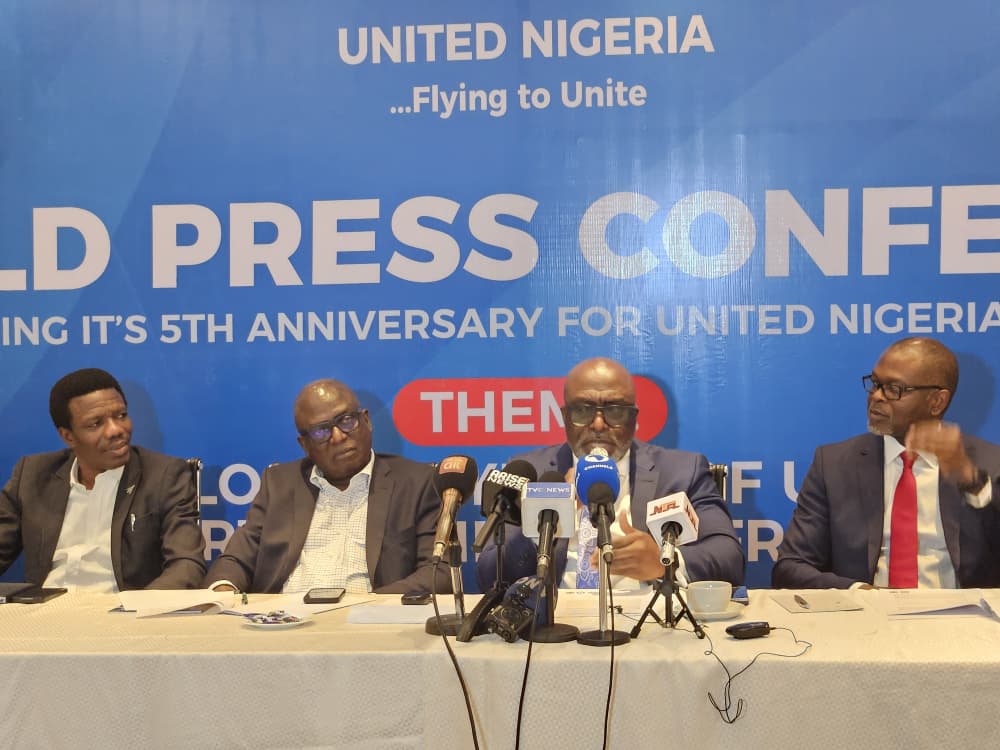
“We started modestly in the middle of a pandemic. But we were clear about one thing — growth must be structured, sustainable and globally benchmarked”, he said at the anniversary press conference themed “From Vision To Velocity – Five Years of United Growth: Charting the Next Frontiers”.
The Fleet That Signals a New Era
The most ambitious phase of UNA’s evolution is now in motion.
The airline has ordered 11 aircraft, including two Airbus A330-200 wide-body jets and six Boeing 737-800 NGs, while negotiating for three additional 737-800s. By mid-2026, the fleet is projected to rise to 21 aircraft — more than double its current size.
One of the A330-200 wide-body aircraft is scheduled for delivery on July 26, 2026, with the second arriving in October. These jets will power the airline’s long-haul ambitions, including a planned direct service to New York by the end of the second quarter of 2026.
Beyond New York, UNA’s expansion blueprint includes:
Regional and continental routes such as Dakar, Monrovia and Johannesburg,
Gulf destinations including Dubai and Jeddah.
European cities like Rome and the UK.
Expanded American operations.
For a Nigerian-owned carrier, the introduction of A330 wide-body aircraft marks a significant statement: a readiness to compete on the world’s busiest long-haul corridors.
Beyond Flying: Building a Self-Sustaining Ecosystem
UNA’s strategy for the next five years extends well beyond fleet expansion.
The airline plans to establish a full Maintenance, Repair and Overhaul (MRO) facility within three years, reducing dependence on third-party maintenance providers and insulating itself from operational bottlenecks that have historically plagued Nigerian carriers.
Even more striking is its decision to pursue listing on the Nigerian Exchange Group (NGX) within three years.
In a domestic aviation market where most airlines remain privately held, often wary of regulatory scrutiny and public accountability — UNA’s openness to going public stands out.
Listing on the NGX would require quarterly audited financial disclosures, a governance structure aligned with global best practices and a shift from founder-driven control to broader shareholder participation. Many airline founders have historically resisted this move, citing fears of shareholder interference, market volatility and exposure during loss-making years. But UNA’s management believes transparency is not a burden — it is a strength.
In an industry notorious for thin margins and economic turbulence, going public could provide long-term capital stability, enhanced credibility and institutional discipline.
Defying the Odds
Aviation is globally known as a high-revenue, low-margin industry. In Nigeria, those margins are further squeezed by exchange rate instability, high operating costs, airport infrastructure limitations and regulatory complexity.
Yet UNA has maintained steady growth without overextending itself. It has scaled methodically, secured aircraft strategically and aligned its operations with international safety standards.
The airline’s expansion narrative is not framed as bravado, but as preparedness.
From four aircraft during a pandemic to a projected 21-aircraft fleet by 2026, UNA’s trajectory reflects a carrier determined to transform from a national connector into a continental force.
A Continental Vision
Okonkwo’s broader ambition is clear: to transform UNA from a leading national carrier into a recognised continental aviation powerhouse and eventually, a strong intercontinental competitor.
Despite the structural challenges facing Nigeria’s aviation ecosystem, the airline believes an indigenous carrier can become a global reference point.
They are not simply adding routes; they are redefining what sustainable airline growth looks like in Nigeria.
As UNA moves from vision to velocity, the next chapter will test whether its careful planning, disciplined expansion and commitment to transparency can indeed reshape Nigeria’s aviation narrative.
For now, five years on from that modest Lagos–Enugu flight, one thing is evident:
United Nigeria Airlines is no longer just taking off; it is accelerating toward the world stage.