

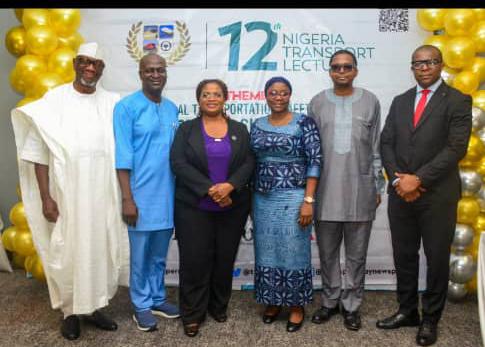
Nigeria’s economic growth and competitiveness will depend largely on the development of safer, more efficient and better-connected transport systems, stakeholders have said at the 12th Nigeria Transport Day Lecture held in Lagos.
The Federal Government, industry regulators, academics and transport operators at the event stressed that transportation particularly maritime and multimodal systems remains critical to trade expansion, industrial productivity and national development.
Speaking on behalf of the Minister of Marine and Blue Economy, Dr. Adegboyega Oyetola, a Director in the ministry, Mrs. Rashidat Yusuf, described transportation as central to economic progress.
“Transportation remains the bedrock of national economic development. Our waters have become safer, enhancing trade. Furthermore, the development of inland waterways has reduced the stress on roads and enhanced the faster movement of goods across different parts of the country”, Yusuf said.
She noted that ongoing investments in maritime infrastructure, inland waterways and port operations are already improving cargo movement efficiency and boosting confidence among shipping operators.
Also speaking, Registrar of the Council for the Regulation of Freight Forwarding in Nigeria (CRFFN), Mr. Kingsley Igwe, said Nigeria must urgently scale up the use of water transport to reduce logistics costs and improve trade efficiency.
“Nigeria’s continued dependence on road transportation has constrained trade efficiency and increased logistics costs, with implications for inflation and the prices of goods and services”, Igwe stated.
He called for sustained investment in dredging, port infrastructure and navigational systems to unlock the full economic potential of the maritime sector.
In his presentation, former Corps Marshal of the Federal Road Safety Corps (FRSC) and Chairman of the Chartered Institute of Logistics and Transport (CILT), Dr. Boboye Oyeyemi, said transportation remains the “lifeblood of economic development, social integration and national competitiveness”.
Oyeyemi revealed that about 90 per cent of freight and passenger movement in Nigeria is currently handled by road, warning that the imbalance is unsustainable.
“Overreliance on roads has accelerated infrastructure deterioration, heightened safety risks and placed enormous pressure on a network where only about 40 per cent of roads are paved”, he said.
He added that Nigeria’s freight and logistics market is projected to grow from $10.95 billion in 2025 to $11.66 billion in 2026, creating opportunities in intermodal logistics, cold-chain transportation and e-commerce distribution.
The experts also noted that improved transport connectivity would strengthen Nigeria’s position under the African Continental Free Trade Area (AfCFTA), where efficient logistics systems are essential for boosting intra-African trade.
Earlier, Publisher of Transport Day Newspapers, Mr. Frank Kintum, said the annual lecture was designed to foster collaboration among stakeholders and generate practical solutions for the sector.
He expressed optimism that recommendations from the forum would support policy reforms and accelerate the development of a safer, integrated and globally competitive transport system in Nigeria.