



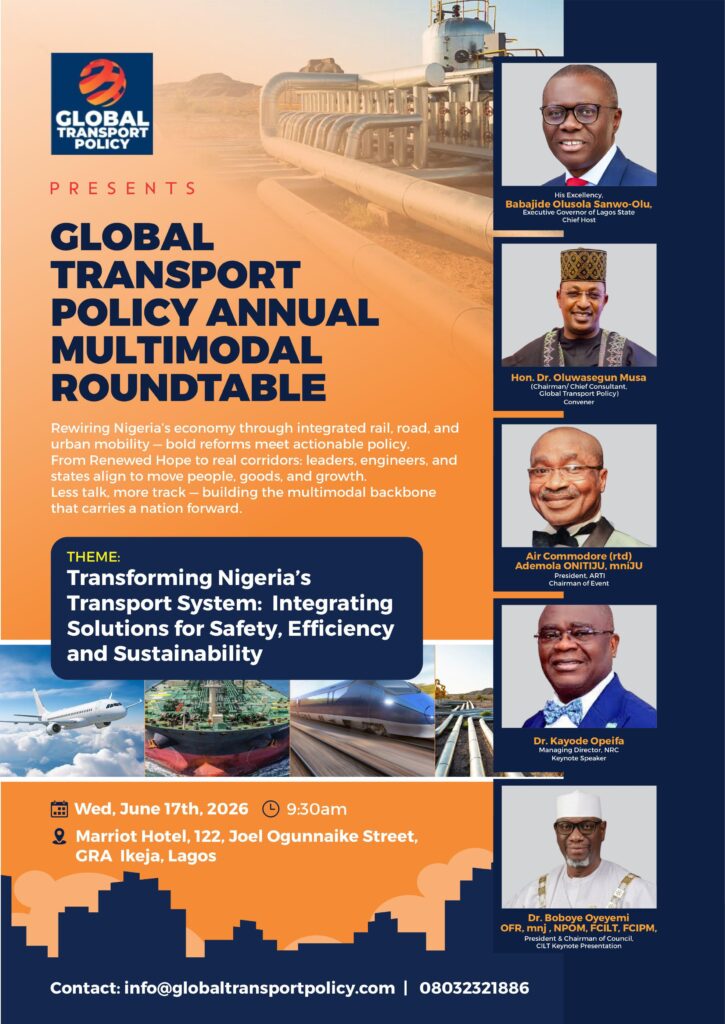
All roads lead to the Marriott Hotel tomorrow as the Global Transport Policy (GTP) Annual Multimodal Roundtable Conference brings together a cross-section of influential voices to chart a new course for Nigeria’s transport system.
Dignitaries, technocrats, Silicon Valley founders, government officials, academics, industry leaders, and media professionals are expected to converge for what organisers describe as a bold and thought-provoking engagement. This year’s edition promises to be insightful, innovative, and solution-driven.
Key global partners billed to attend include the European Union (EU), African Union (AU), African Development Bank (AfDB), and the Economic Community of West African States (ECOWAS), among others underscoring the international significance of the conference.
Speaking at a pre-event press briefing, the Chief Consultant, Global Transport Policy (GTP), Dr. Segun Musa, said the conference would confront longstanding barriers hindering the effective implementation of a multimodal transport system in Nigeria.
According to him, weak policy direction, insufficient political will, and the absence of capable technocrats to drive execution remain major setbacks.
He emphasised that in a properly structured multimodal system, competent technocrats should be empowered to deliver solutions without unnecessary bureaucratic bottlenecks.
Drawing from historical context, he recalled that between the 1960s and mid-1990s, Nigeria’s rail system enabled seamless cargo movement from the hinterland to urban centres, where goods were efficiently distributed to markets and end users.
He lamented the current inefficiencies in the transport sector, noting that significant volumes of perishable goods are lost in transit due to delays and poor logistics. This, he explained, forces producers to transfer losses to consumers, ultimately driving up the cost of commodities.
“If we can position transport effectively, it will significantly enhance our supply chain”, Musa stated.
He further linked Nigeria’s transport challenges to declining agricultural productivity, arguing that poor logistics discourage farmers from expanding production.
“Many people are not going into farming because there is no effective transport system. Until we fix transportation, we cannot expect a return to large-scale farming or achieve food security”, he said.
Musa also highlighted the impact on manufacturing, where high logistics and production costs particularly in transporting raw materials and equipment have made locally produced goods less competitive compared to imports.
“We have people willing to go into manufacturing, but without an efficient transport system to support supply chain distribution, their efforts are often frustrated”, he added.
Questioning the drivers of rising inflation, he pointed to transport inefficiencies as a critical factor behind the high cost of goods and reduced consumer purchasing power.
“Until we get transport right, we won’t get anything else right”, Musa concluded.
The GTP Roundtable is expected to generate actionable recommendations to reposition Nigeria’s transport architecture and unlock growth across key sectors of the economy.