



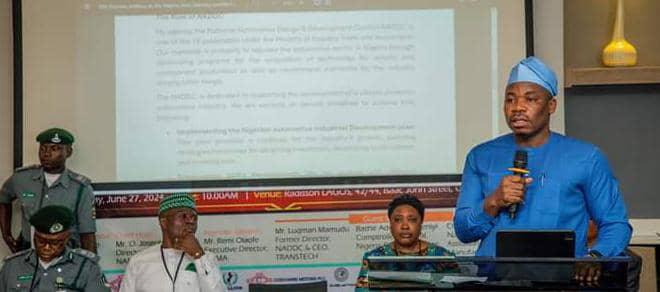
Director General of the National Automotive Design and Development Council (NADDC), Mr. Oluwemimo Osanipin, has urged all the stakeholders in the Nigeria Automotive industry to come together and chart a course for a successful future.
Osanipin made the call while delivering his keynote address at the maiden edition of the Nigeria Auto Industry Summit held in Lagos on Thursday, June 27.
He cited the lack of robust infrastructure and investment as a significant challenge to the industry, noting that addressing challenges is paramount to unlocking the industry’s full potential.
According to him, Nigeria’s Automotive Industry holds immense potential for growth and development, provided that key challenges are addressed, opportunities are leveraged, and strategic initiatives are implemented.
“The Nigeria Automotive Industry holds immense potential. With a growing population and a rising demand for safe, reliable, and affordable vehicles, the opportunities are vast. However, we also face significant challenges.
“I’m sure you will agree that one of the most pressing concerns is our reliance on imported vehicles. In 2023, the value of passenger cars imports jumped to ₦1.47 trillion, a 224.67 per cent increase from 2022(NBS).
“This puts pressure on our Forex, hinders job creation and economic growth within our Country,” he pointed out.
Osanipin, however said all hope is not lost as the country is also making strides in its drive to develop the sector.
“Nigeria has a number of local assembly plants in operation and the government is more than ever committed to seeing the industry thrive,” he said.
He said the success of the Nigeria Automotive Industry hinges on collaboration with willing industry stakeholders who are willing to invest in local production of vehicles, most especially spare parts.
The NADDC boss argued that the inauguration of the Implementation Committee of the 2023 National Automotive Industry Development Plan (NAID) and the adoption of locally assembled CNG-powered vehicles by the federal government is proof of its desire to ensure the development of the automotive sector of the economy.
Osanipin commended the Nigeria Auto Journalists Association (NAJA) for organising the summit, noting that the media also has a role to play, especially in shaping public perception about locally manufactured vehicles and parts.
Earlier in his remark, Lagos State Commissioner of Transport, Mr. Oluwaseun Osiyemi, said the Auto indusytry not only drives economic growth but also fosters innovation, creating jobs, and enhancing the overall quality of life for our citizens.
He also called for strategic partnerships in the industry that would aid its contribution to the economy.
He said: “The Lagos State Government is committed to creating an enabling environment that supports industry stakeholders, fosters collaboration, and encourages investment.
“We believe that through strategic partnerships and innovative initiatives, the auto industry can significantly contribute to the revival and growth of our nation’s economy.”
On his own part, the Executive Director, Nigeria Automotive Manufacturers Association (NAMA), Mr. Remi Olaofe, urged the government to revive tyre, battery, and glass manufacturing as a precursor to reviving local manufacture of key components.
He said the automotive industry in Nigeria has faced policy uncertainties and changing regulations, which can make it difficult for manufacturers to plan long-term investments.
According to him, access to affordable financing remains a hurdle for both established manufacturers and potential newcomers to the industry.
“In addition, the interest rates offered by Nigerian banks are significantly higher compared to other countries, making it difficult for manufacturers to access affordable financing for expansion and investment in new technologies,” he added.
Meanwhile, the Minister of Industry, Trade and Investment, Doris Uzoka-Anite who was represented at the event by Deputy Director, Industry Development Department, Mrs. Olumuyiwa Ajayi-Ade, assured stakeholders that the federal government is committed to creating an enabling environment for the automotive sector to thrive.
The Minister acknowledged challenges in the sector, such as inadequate access to finance, limited local content in vehicle production, and the need for policy consistency.
She said the federal government is committed to working with industry stakeholders to overcome challenges and create a conducive environment for growth.
“With the right policies, investments, and collaborative efforts, we can transform this sector into a significant driver of economic growth and development.
“I urge all stakeholders; government agencies, private sector players, financial institutions, and development partners to join hands in this endeavour,” Uzoka-Anite appealed.