




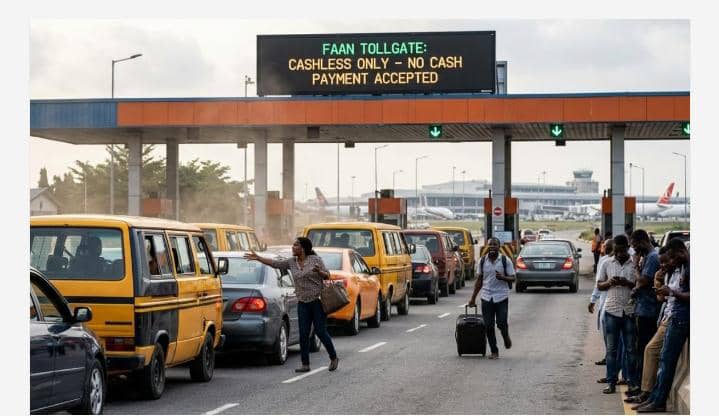
President Bola Tinubu has ordered the immediate suspension of the Federal Airports Authority of Nigeria (FAAN)’s cashless toll payment policy following widespread disruption and traffic gridlock at the nation’s major airports.
The directive was announced by the Minister of Aviation and Aerospace Development, Festus Keyamo, after the Federal Executive Council (FEC) meeting at the State House in Abuja.
The policy, which took full effect on March 1, 2026, was designed to eliminate cash handling at airport toll gates in a bid to curb revenue leakages and improve transparency. However, its rollout triggered severe vehicular congestion at key gateways, including the Murtala Muhammed International Airport (MMIA), Lagos, and the Nnamdi Azikiwe International Airport, Abuja. Many passengers reportedly missed their flights due to long queues caused by payment bottlenecks.
In response, President Tinubu directed a temporary return to a hybrid payment system. Motorists will now be allowed to pay using either cash or the designated “Go Cashless” cards and Point-of-Sale (POS) terminals.
While reaffirming his administration’s commitment to digital reforms aimed at reducing corruption and optimising revenue collection, the President stressed that modernisation efforts must not undermine operational efficiency or citizen welfare.
Keyamo said the ministry would revisit the implementation framework to develop a more seamless electronic solution, potentially involving private-sector partners to enhance the technology and improve user experience.

Before the suspension, FAAN had issued over 70,000 “Go Cashless” cards. However, heavy reliance on POS transactions for motorists without the cards compounded by network failures was identified as a major factor behind the congestion.
The troubled rollout underscored the challenges of implementing large-scale digital reforms in a country of over 200 million people, especially at time-sensitive infrastructure like airports.
At the MMIA toll gate in Lagos, queues reportedly stretched several metres, with some travellers abandoning their vehicles to board commercial motorcycles at inflated fares in order to catch departing flights.
Passengers described the experience as frustrating emphasising that successful digital transformation requires robust system testing under peak conditions, extensive public sensitisation, multiple payment options during transition phases, and visible support teams to guide users.
Industry observers said the episode highlights the delicate balance between modernisation and operational stability, particularly in high-traffic environments where efficiency, reliability and customer experience are critical.
For now, the government appears focused on recalibrating the reform to ensure that future implementation achieves its transparency goals without disrupting airport operations.