



“Residents of Okun Afa/Alpha Beach say decades of advancing shoreline have swallowed homes, farms, businesses and public facilities, leaving the community with little room to retreat”
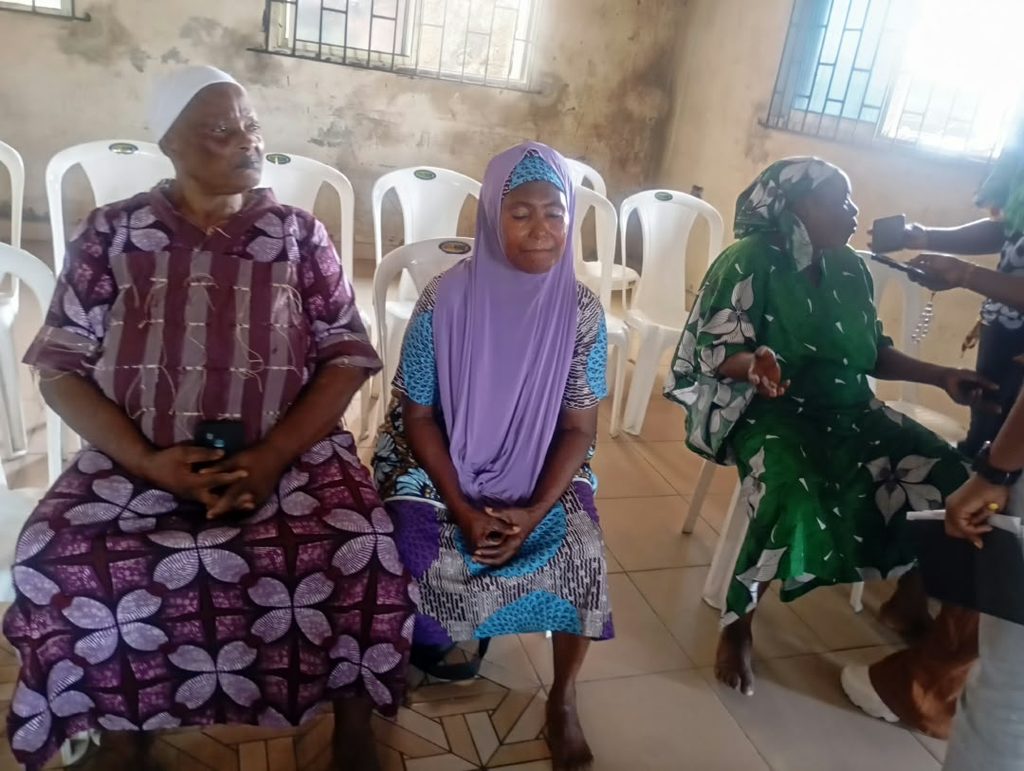
Residents of Okun Afa, popularly known as Alpha Beach community in Lagos State, are once again battling the encroaching sea, which they said has continued to swallow homes, farmland, businesses and public facilities, prompting an intensified appeal to the government to save what they describe as the community’s last remaining foothold.
For decades, the residents have watched the sea steadily advance into the community, forcing successive generations to abandon homes and move further inland. But residents said there is now hardly any land left to retreat to, with the remaining settlement squeezed between the advancing coastline and the Lagos-Calabar Coastal Highway.
In a field trip organised by an NGO, ‘Renevlyn Development Initiative’ to round off its training on Women and Extraction Journalism, journalists had first hand information from the Okun Afa women who expressed grief on their battle with sea encroachment over the years.
For residents such as fish seller Mrs. Okonlawon Kazim, the crisis has gone beyond the destruction of property. The advancing sea has taken away the homes and farmland that once provided shelter and income for her family, leaving her without a permanent place to live.
“My father’s house, the sea has carried it away. My mother’s house is at Owode down there, it has been destroyed”, Kazim said.
“As I’m speaking to you presently, I sleep outside”.
Her experience reflected the growing vulnerability of the wider Alpha Beach community, where the loss of land has also translated into the loss of livelihoods, trading spaces and access to basic services.
The threat is not merely a recent development.
Environmental assessments and previous studies have documented persistent shoreline retreat along the area, with a 2024 Environmental and Social Impact Assessment for the Lagos-Calabar Coastal Highway identifying substantial erosion between Alpha Beach and Iwerekun.
The assessment’s long-term analysis covering 1974 to 2024 recorded erosion across 93.4 per cent of the transects examined in one affected sector and described Alpha Beach as “currently seriously eroding”.
A Community Running Out of Room
For the Okun Afa community, moving inland has historically been the most practical response to the advancing sea.
But community leader and Chairman of the Okun Afa/Alpha Community Development Association, Hon Prince Sheriff Elegunshi, said that option is rapidly disappearing.
He said successive settlements had been established as earlier ones were consumed by the sea, leaving the present community as what residents fear could be their final refuge.
“The first community are submerged. Second community is another thing submerged. Third community are also submerged. Why is the fourth and the last”? he asked.
Elegunshi said the remaining community is now trapped between the Atlantic Ocean and the Lagos-Calabar Coastal Highway, leaving residents with virtually no direction in which to relocate.
“The only solution is for the government to come and continue the road breakers and also do reclamation the way they did for Eko Atlantic City’, he said.
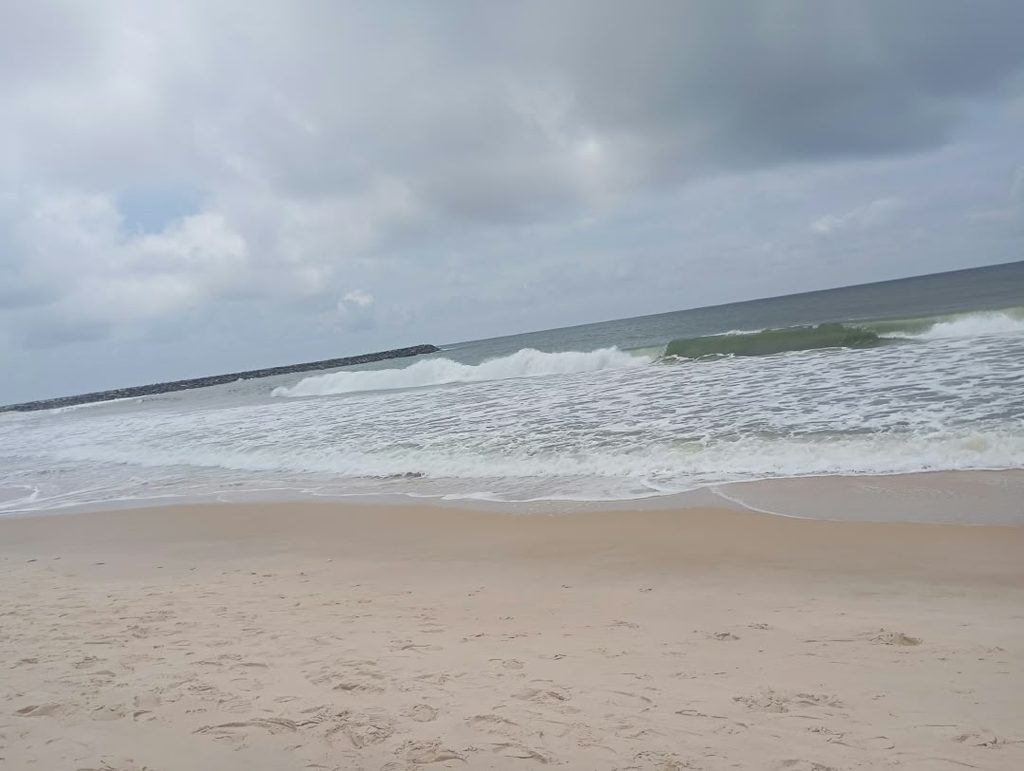
His account is consistent with previous research on Alpha Beach. A study by the National Open University of Nigeria found that coastal erosion had damaged infrastructure and property, disrupted businesses and contributed to the relocation of residents.
It also found that traditional coping measures, including sandbags, sand mounds and sand fencing, were inadequate to withstand the scale of the coastal threat.
When the Sea Takes the Land, Livelihoods Disappear
The impact of the encroaching sea is being felt not only in homes but across the community’s economic life.
Fishing, farming, food processing and petty trading have traditionally provided income for residents. But as the shoreline and available land have disappeared, many of those activities have become increasingly difficult or impossible to sustain.
Kazim said she had been selling fish since 1993 but stopped about three years ago after the community lost the landing areas where fishermen previously brought their boats.
“Fish-selling has stopped. I don’t sell fish anymore”, she said.
She recalled a time when fishermen arrived with fresh catches, enabling traders to buy directly from them.
But with no reliable landing area, she said fishermen now struggle to bring their boats close enough for traders to purchase their catch.
The disappearance of farmland has compounded the problem
Kazim said residents once cultivated cassava, mangoes and coconuts, with families processing cassava into garri and harvesting fruits from nearby farms.
“Now there’s nothing anymore. There’s no farm, no garri, no anything”, she said.
“There isn’t even land left for us to plant anything on — the sea has consumed all of it”.
Women Bear the Brunt
Women whose livelihoods depended on fishing and trading have also suffered significant losses.
Morayo Liyadi said she previously sold fish and frozen food but lost the space and equipment needed to continue the business.
“I even sold my fridge because there was nowhere to keep and sell fish”, she said.
She said she now cooks food for sale and buys fish in small quantities whenever fishermen are able to bring their catch into the community.
“If I buy iced fish, I carry it on my head and move around because we have no place to keep and sell fish”, she said.
Liyadi said she has lived in a wooden structure for about nine years after water destroyed her house.
Her experience highlighted the wider socioeconomic consequences of the crisis. For households dependent on fishing, farming, food processing and small-scale trading, the loss of land means not only losing property but also losing the physical foundation of their livelihoods.
Basic Services Also Displaced
Residents said the continuing encroachment has affected access to essential public services.
According to Liyadi, the community no longer has a functioning health centre, forcing residents to travel to Egbo Efon for medical treatment.
She said pregnant women sometimes have to travel outside the community to give birth, while some residents rely on traditional birth attendants because of the distance and cost involved in accessing formal healthcare.
“If there was a hospital in this town, delivery costs would be lower'”, she said.
Call for a public school
Residents are also calling for a functioning public school closer to the community, saying many families cannot afford private education.
Liyadi said children often have to travel considerable distances to access government schools.
The claims regarding the availability and condition of public facilities would require verification through official records and physical inspection. However, the reported displacement of basic services underscored the broader challenge of providing infrastructure in communities repeatedly affected by environmental displacement.
Residents Recall Earlier Intervention
The community said government intervention has previously demonstrated that coastal protection measures can reduce the immediate impact of the waves.
Elegunshi credited the administration of former Lagos State Governor, Babatunde Fashola with installing wave breaker along the shoreline.
“The wave breaker that we are seeing at the seaside reduce the wave power but one is not enough, we need more”, he appealed.
Residents at the time said the intervention reduced the impact of ocean surges, although sand continued to be lost from parts of the shoreline.
The experience suggested that coastal defence structures can reduce immediate exposure but may not, on their own, provide a permanent solution to persistent shoreline retreat.
A Community on the Edge
For residents, however, the issue is ultimately about survival.
Fatimo Gbadebo, popularly known as Iya Oosa of Okun Afa/Alpha Beach, said residents remained grateful that the encroaching sea had not, in her experience, resulted in loss of lives.
But she said the destruction of homes had reached an alarming level.
“The sea has destroyed many houses, but it has not taken lives from us”, she said.
She appealed to the government to intervene before the remaining homes and community infrastructure disappear leaving no settlement for them.
For Kazim, the crisis has already erased much of the family security she once knew.
“My father was a native of this town”, she said. “The house that was my father’s house, the sea has carried it away”.
Her story captures the dilemma confronting the entire community: as the sea advances and the available land shrinks, there is increasingly nowhere left to move.
The residents are therefore calling for stronger coastal protection, effective drainage, healthcare, education and support for families who have lost homes and livelihoods.
But any lasting solution will need to go beyond the construction of another barrier.
Protecting Alpha Beach will require coordinated planning involving coastal defence, drainage, road construction, land-use management, environmental monitoring and livelihood support.
For Okun Afa, the clock is already ticking.
The immediate question is whether the authorities can protect the community’s remaining foothold before the fourth settlement becomes the next one swallowed by the sea.