




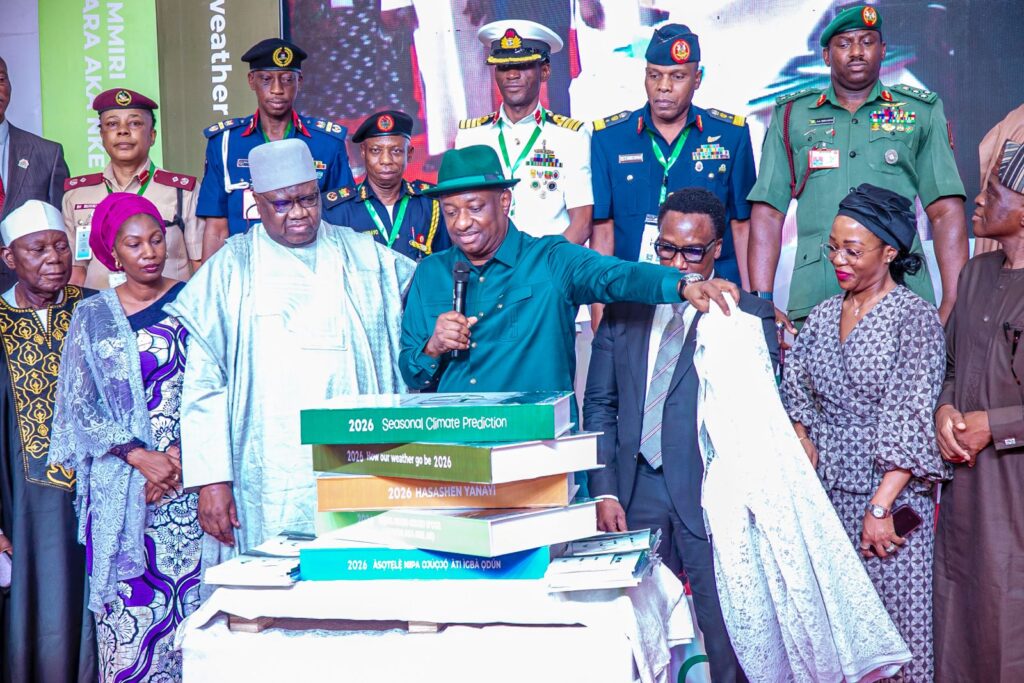
The federal government has unveiled Nigeria’s 2026 Seasonal Climate Prediction (SCP), warning of warmer temperatures, prolonged dry spells, shifting rainfall patterns and an intense “August Break” in parts of the country, as it moves to place climate science at the heart of national planning.
Minister of Aviation and Aerospace Development, Festus Keyamo, presented the forecast on Tuesday at the Nigerian Air Force (NAF) Conference Centre, Abuja, describing the SCP as a “strategic enabler of national development” and a vital tool for agriculture, aviation safety, infrastructure, food security and disaster risk reduction.
He said climate variability and change now shape economic decisions, aviation operations, national security and the wellbeing of Nigerians, stressing that early-warning systems must guide governance.
“The days of viewing weather and climate warnings as a distant danger are behind us. Timely and accurate weather information is no longer optional, but a strategic enabler of national development and good governance” the Minister said.
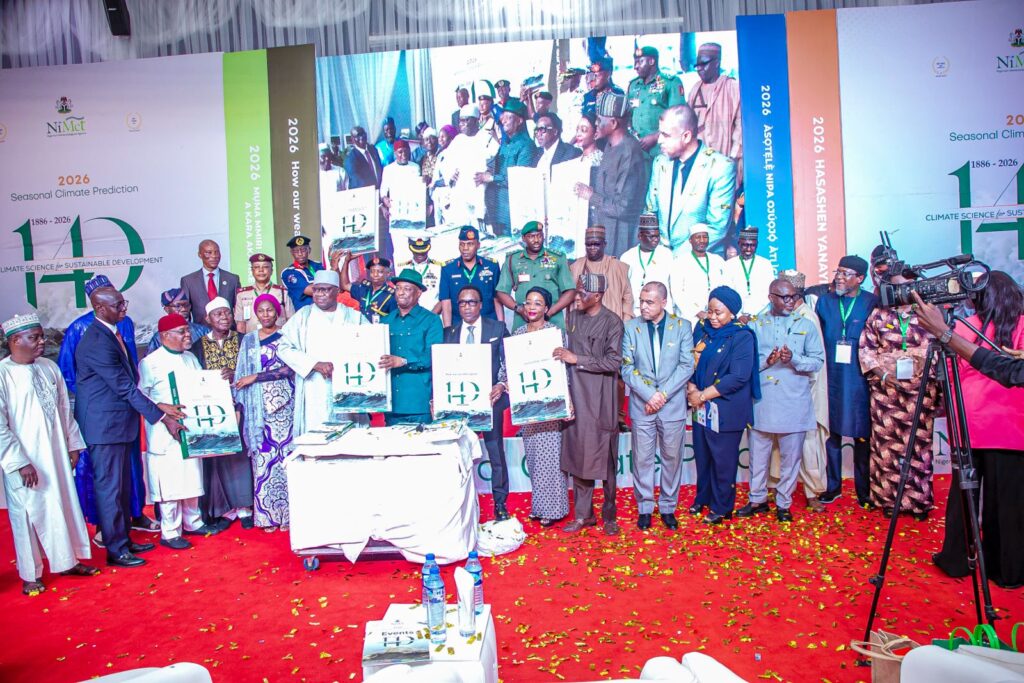
He noted that the SCP aligns with the priorities of President Ahmed Tinubu’s administration on economic stability, food security, infrastructure resilience and climate adaptation, adding that government would continue to empower the Nigerian Meteorological Agency (NiMet) to deliver reliable climate services.
According to Keyamo, the 2026 prediction is built on global best practices, using long-term climatological data and climate drivers such as the El Niño–Southern Oscillation (ENSO) and the Indian Ocean Dipole (IOD), which currently point to a predominantly neutral ENSO phase with implications for rainfall distribution and sectoral risks.
Key Highlights of the 2026 Forecast
The Minister cautioned that early rains already recorded in parts of the South do not signal the start of the rainy season, urging farmers and rainfall-dependent sectors to rely on NiMet’s official onset dates.
NiMet projects early rainfall onset in Bayelsa, Rivers, Akwa Ibom, Cross River, Benue, Kogi, Nasarawa, Oyo and parts of Kebbi, Niger, Jigawa, Katsina, Kano, Adamawa and Taraba, while late onset is expected in Borno State.

Rainfall cessation is expected to be earlier than normal in parts of Ogun, Osun, Ondo, Imo, Rivers, Akwa Ibom, Kogi and Niger, but later in Lagos, Ogun, Anambra, Enugu, Cross River, Benue, Nasarawa and Kaduna.
A longer-than-normal rainy season is forecast for Lagos, Benue, Enugu, Ebonyi, Ogun, Oyo, Nasarawa, Anambra, Kwara, Kebbi, Kaduna, Gombe and Taraba, while parts of Borno, Yobe and Niger may experience a shorter season.
Most of Nigeria is expected to record normal annual rainfall, but above-normal rainfall is projected for Borno, Sokoto, Kebbi, Kaduna, Enugu, Cross River, Abia, Ebonyi, Akwa Ibom and the Federal Capital Territory. Below-normal rainfall is anticipated in parts of Katsina, Zamfara, Kwara, Oyo and Ogun.
Between March and May, severe dry spells exceeding 15 days may occur in parts of Oyo and Ogun, with moderate dry spells across Ekiti, Kogi, Osun, Ondo, Edo, Ebonyi, Abia, Cross River and Delta. During June to August, severe dry spells lasting up to 21 days are predicted in parts of Bauchi, Borno, Gombe, Jigawa, Katsina, Kano, Kebbi, Kwara, Nasarawa, Niger, Plateau, Sokoto, Yobe and Zamfara.
The Little Dry Season (August Break) is expected to begin late July and be severe over Lagos, Ogun, Ekiti and parts of Oyo, with 28 to 40 days of little or no rainfall.

Both daytime and nighttime temperatures are also projected to be warmer than the long-term average across most parts of the country in January, February, March and May 2026.
NiMet Moves to AI-Driven Forecasting
In his remarks, NiMet Director General and CEO, Prof. Charles Anosike, said the Agency is strengthening science-based forecasting to protect lives, livelihoods and infrastructure amid growing climate threats.
He disclosed that NiMet has established a team of experts to integrate Artificial Intelligence into weather forecasting operations to improve accuracy and service delivery.
“Timely and reliable weather and climate information have become indispensable for building safer and more climate-resilient communities across the country”, Anosike said.
The Director General said NiMet is expanding partnerships to downscale the SCP to local farmers, adding that digital advisory services are being fast-tracked with local and international collaborators. He called on state governments to deepen collaboration so climate information reaches more communities.
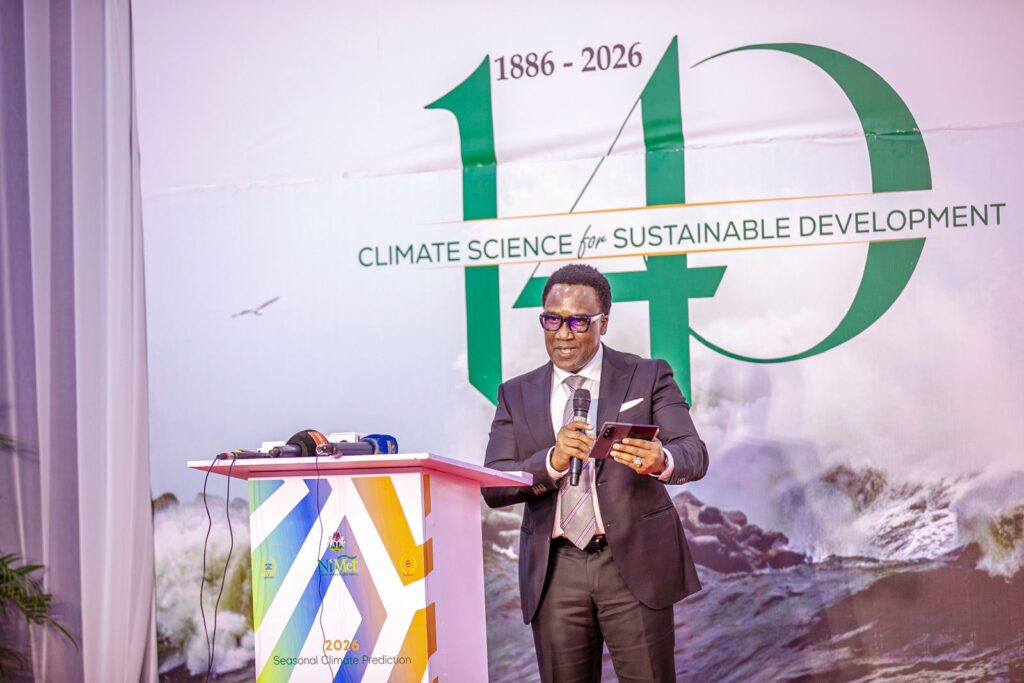
Anosike also acknowledged the historical role of the agency and credited the pioneer leadership of Chief Lihwu Akeh for laying NiMet’s institutional foundation.
Climate Science as National Insurance
Keyamo stressed that any development not informed by credible climate knowledge is “vulnerable, costly and unsustainable,” urging ministries, state governments, the private sector, academia and the media to support the dissemination and application of the SCP.
“Nigeria must be at the forefront of building and adopting systems that can survive and thrive in future climate scenarios,” he said.
The unveiling of the 2026 SCP, he added, reflects Nigeria’s growing commitment to science-based planning, foresight and resilience, positioning climate data as a core pillar for sustainable economic growth and safer communities nationwide.