


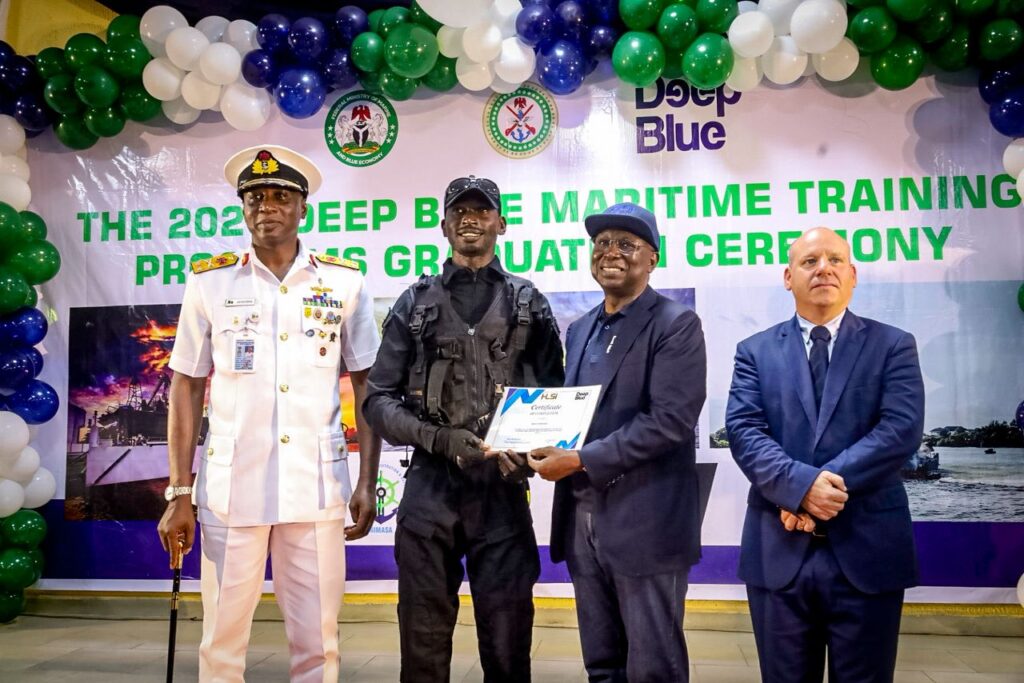
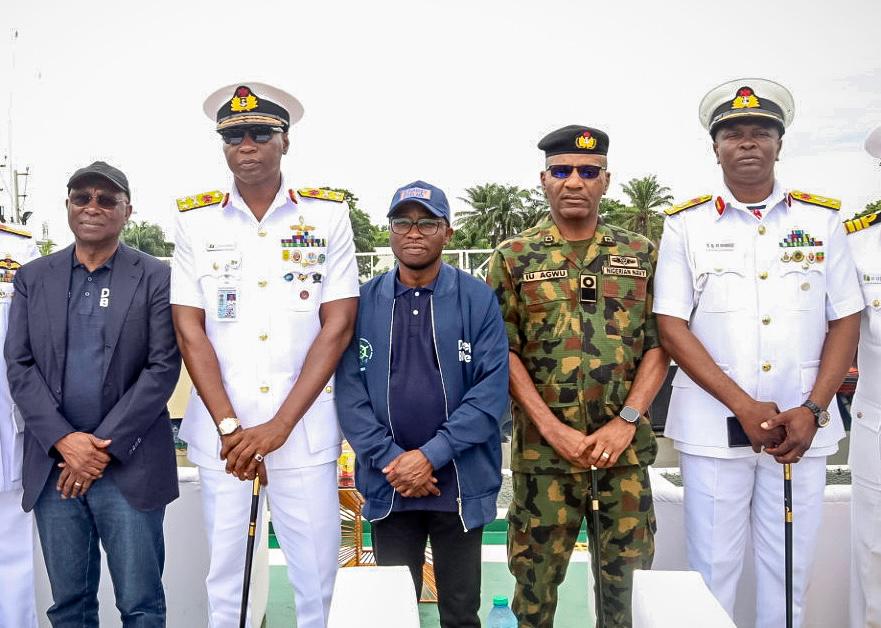
The Nigerian Navy and the Nigerian Maritime Administration and Safety Agency (NIMASA) have reaffirmed their commitment to deeper collaboration in securing the nation’s maritime domain, as 177 personnel graduated under the Deep Blue Project.
Chief of the Naval Staff, Vice Admiral Idi Abbas, said sustained inter-agency cooperation remains critical to tackling maritime crime and safeguarding Nigeria’s waters and the Gulf of Guinea. He spoke at the graduation ceremony, represented by the Flag Officer Commanding, Western Naval Command, Rear Admiral Abdullahi Mustapha.
Abbas described the Deep Blue Project as a strong example of effective collaboration among security agencies, stressing that modern security challenges require professionalism, vigilance, and continuous capacity development.
He commended the trainees for their impressive performance during operational demonstrations, noting that their display reflected the level of preparedness required to protect Nigeria’s maritime environment.
Also speaking, the Director General of NIMASA, Dr. Dayo Mobereola, said the agency remains committed to strengthening maritime security through strategic partnerships and sustained investment in capacity building.
Mobereola disclosed that the graduates include Special Mission Vessel officers and engineers, fast intervention boat operators, technicians, boarding team personnel, and helicopter units trained in specialised areas such as tactical operations, medical evacuation, unmanned aerial systems, and communications.
He said the training is designed to enhance operational efficiency, improve intelligence coordination, and boost rapid response capabilities across Nigeria’s maritime space.
The NIMASA boss noted that Nigeria has recorded zero piracy incidents for four consecutive years, attributing the milestone to the Deep Blue Project. According to him, the achievement has improved global confidence in Nigeria’s waters, reduced war-risk insurance costs, and supported the country’s election into Category C of the International Maritime Organisation (IMO).
Mobereola also acknowledged the support of the Minister of Marine and Blue Economy, Adegboyega Oyetola, as well as the contributions of the Armed Forces, Homeland Security International, the Department of State Services, and the Nigerian Police.
He reaffirmed NIMASA’s resolve to sustain collaboration with stakeholders to ensure safer waterways and support the growth of Nigeria’s maritime and blue economy.
The event featured a live operational demonstration involving special mission vessels, helicopters, fixed-wing aircraft, and interceptor boats in a simulated rescue mission of a vessel under attack.