



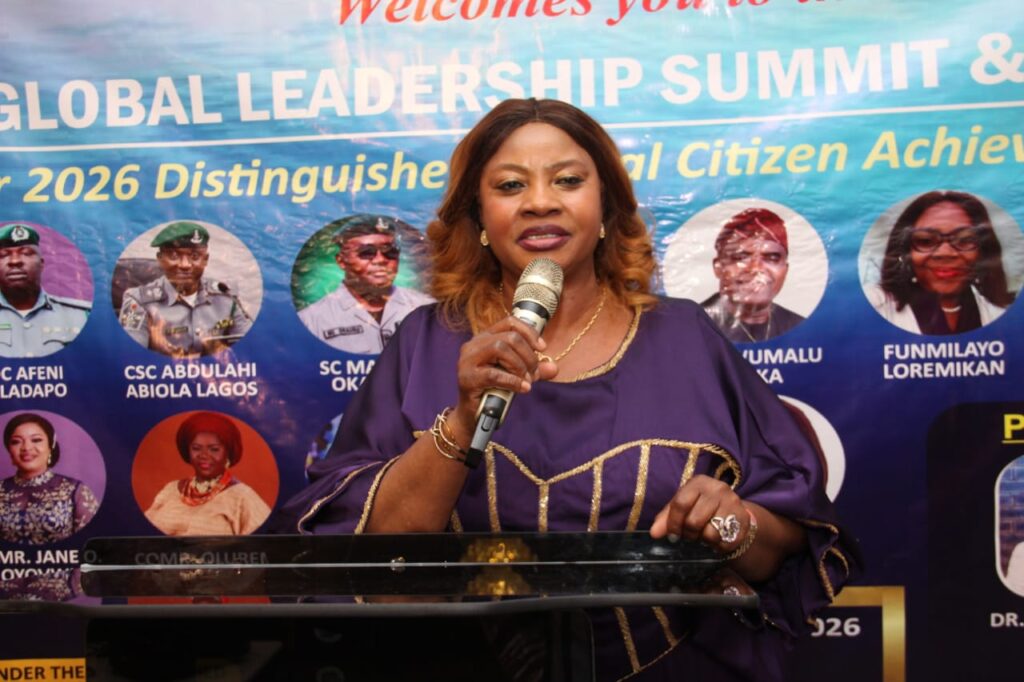
Director, Financial Services Department of the Nigerian Maritime Administration and Safety Agency (NIMASA), Dr. (Mrs.) Odunayo Ani, has called for a broader financing strategy to unlock Nigeria’s blue economy, stressing that government funding alone cannot meet the sector’s growing investment needs.
Ani, who is also President of the Women’s International Shipping and Trading Association (WISTA) Nigeria, said stronger institutional governance, diversified capital and inclusive leadership were essential to transforming the country’s maritime assets into sustainable economic value.
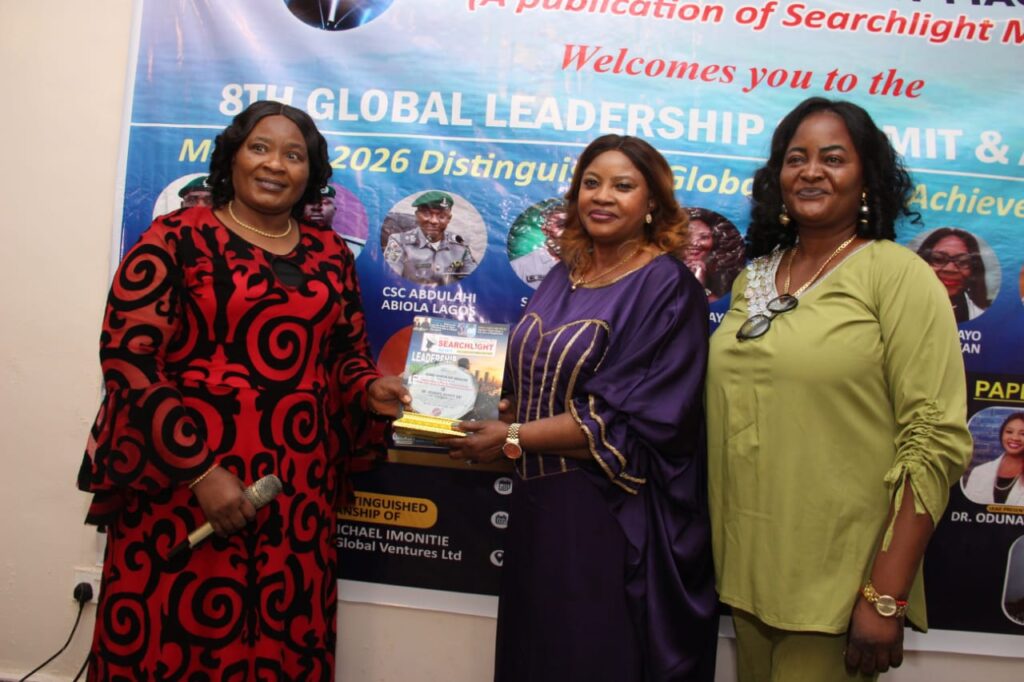
She made the call while presenting a paper titled “Financing the Blue Economy: Strengthening Institutional Governance, Financial Sustainability and Women’s Leadership for Nigeria’s Maritime Future” at the 8th Global Leadership Summit & Award 2026.
Ani said Nigeria did not have a blue economy potential problem, noting that the country’s Blue Economy Policy, established in August 2023, had provided a policy foundation for development.
She said the more pressing challenges were financing, governance and execution, as the country’s waters, ports, shipping companies, fisheries, coastal communities and maritime professionals could only generate greater economic value when supported by adequate capital and effective institutions.
“We need to move from seeing the maritime sector as a cost centre to treating it as a strategic investment platform”, Ani said, stressing that capital follows credible institutions, bankable projects, predictable rules and measurable returns.
She identified shipping, ports, fisheries, aquaculture, offshore energy and maritime services as areas with significant investment potential, adding that Nigeria’s coastline, ports, inland waterways, offshore resources and human capital provide a strong foundation for a broader blue economy.
However, she noted that the government could not finance every port, vessel, technology investment and opportunity across the maritime value chain.
Ani therefore advocated greater use of public-private partnerships, blended finance, blue bonds, dedicated maritime funds and diaspora investment, alongside public funding and private domestic and international capital.
She said the success of these financing options would ultimately depend on investor confidence, which, according to her, is built through transparent institutions, sound policies, independent oversight, reliable reporting and clear accountability.
“Opportunity attracts attention. Governance attracts capital”, she said.
Using the Cabotage Vessel Financing Fund (CVFF) as an example, Ani said the fund was structured at $700 million, with NIMASA providing 50 per cent of the capital, participating banks 35 per cent and shipowners contributing 15 per cent equity.
She said eligible Nigerian shipowners could access up to $25 million each for vessel acquisition, adding that NIMASA had received about 92 applications, with 20 forwarded to 12 approved lending banks for review.
Ani stressed that the creation of a financing fund was only the starting point, saying its effectiveness depended on the governance, oversight and accountability mechanisms surrounding its operation.
She also called for greater public visibility of the performance of maritime financing schemes, noting that there is currently no dedicated public CVFF dashboard or standing public performance report through which stakeholders can regularly track funding and outcomes.
The NIMASA director pointed to international examples of innovative blue economy financing, citing Seychelles’ $15 million sovereign blue bond issued in 2018 and Indonesia’s $150 million sovereign blue bond in 2023.

She said Nigeria could draw lessons from such models while adapting them to the country’s institutional and economic realities.
Ani identified transparent port revenues, well-managed vessel financing and reliable fisheries data as some of the information investors require before committing capital to the maritime sector.
She also highlighted technology as an important enabler of financial transparency and sustainability, citing digital payments and e-invoicing, real-time vessel and cargo tracking, and digital systems for monitoring and reporting.
On women’s participation in the maritime sector, Ani said women remained significantly underrepresented in several areas of the industry, particularly operational and senior leadership positions.
Citing the 2024 IMO-WISTA Women in Maritime Survey, she said women accounted for about 1 per cent of the global seafarer population.
Ani said WISTA Nigeria was contributing to women’s advancement through mentorship, advocacy and professional development, while stressing that participation should translate into greater representation in positions where strategic and financial decisions are made.
She proposed an ANCHOR framework for financing Nigeria’s maritime future, built around Accountability, New Capital, Capacity, Human Capital, Ocean Sustainability and Results.
Ani also proposed five actions for the next 24 months: creating a Blue Economy Project Preparation Facility to develop a pipeline of bankable projects; establishing a Maritime Investment and Risk Platform; publishing a Blue Economy Finance Dashboard; making women’s leadership measurable through targets and progress reporting; and financing the green and digital transition through cleaner vessels, port efficiency, digital trade systems, data and maritime technology.
According to her, the objective should be to build a Nigerian maritime economy that is competitive, inclusive, sustainable and globally investable.
“Nigeria has the maritime assets. Nigeria has the human capacity. Nigeria has the market. Our task is to build the institutions and financing systems capable of turning those assets into sustainable national value”, she said.