




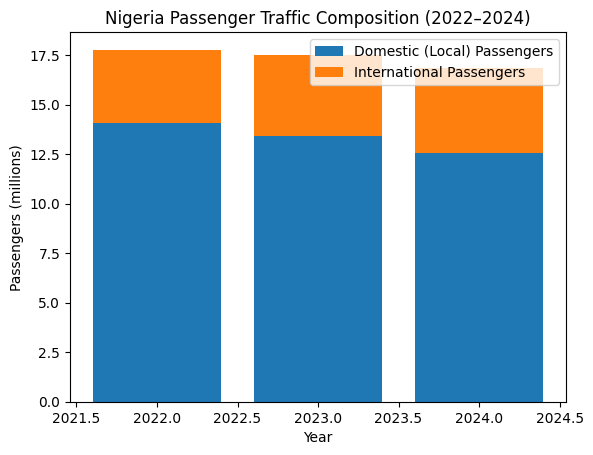
Nigeria’s domestic air travel has continued to contract over the past three years, weighed down by rising operating costs and shrinking airline capacity, even as international passenger traffic records steady growth led overwhelmingly by Lagos Airport, according to Federal Airports Authority of Nigeria (FAAN) data for 2022 to 2024.
An analysis of FAAN’s harmonised passenger figures showed that total passenger traffic across Nigerian airports fell from 17.77 million in 2022 to 16.88 million in 2024, with domestic travel accounting for most of the decline. Domestic passenger numbers dropped consistently each year, while international travel expanded, gradually increasing its share of overall traffic.
In 2022, domestic flights carried 14.06 million passengers, compared to 3.71 million international travellers. By 2024, domestic passenger traffic had fallen to 12.54 million, while international traffic rose to 4.33 million, lifting international travel’s share of total passenger movements from about 21 per cent to nearly 26 per cent.
Year-on-year figures underline the divergence. Domestic passenger traffic declined by 4.6 per cent in 2023 and deepened to 6.5 per cent in 2024, reflecting mounting pressure on local routes. In contrast, international passenger traffic grew by 9.7 per cent in 2023 and 6.5 per cent in 2024, signalling sustained demand for overseas travel despite broader economic headwinds.
Aviation analysts attribute the domestic downturn primarily to rising airfare costs, driven by higher aviation fuel prices, foreign exchange volatility, and maintenance expenses.
These pressures have forced airlines to cut frequencies and rationalise routes, sharply reducing available seat capacity on domestic services where demand is more price-sensitive.
International travel, however, has proved more resilient. FAAN data showed that growth is heavily concentrated at Nigeria’s main gateway airports, particularly Murtala Muhammed International Airport (MMIA) Lagos, where international passenger numbers rose strongly in 2024.
Business travel, diaspora movements and improved aircraft utilisation on international routes have helped offset weaker domestic demand.
Airport-by-airport figures revealed a widening concentration of passenger traffic. Lagos and Abuja airports together accounted for nearly three-quarters of all passenger movements in 2024, up from just under 73 per cent in 2022. Lagos alone handled over 42 per cent of total national passenger traffic in 2024, reinforcing its dominance in Nigeria’s aviation network.
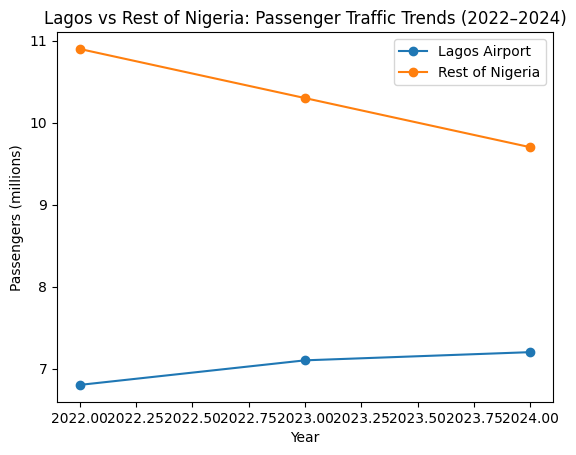
While Lagos recorded overall passenger growth despite a decline in domestic traffic — due largely to a sharp increase in international passengers, Abuja experienced a notable fall in total passenger numbers in 2024, making it one of the largest contributors to the national decline.
Several regional airports dependent almost entirely on domestic travel recorded steeper drops. Airports such as Owerri, Kano, Ilorin and Jos showed sustained declines across the period, highlighting the vulnerability of smaller airports to domestic market contractions and airline capacity cuts.
At the same time, a few airports recorded growth from relatively low bases. Port Harcourt showed resilience, while Katsina and Makurdi posted strong percentage increases, though analysts cautioned that such gains reflect small absolute numbers rather than broad market recovery.
FAAN’s data also pointed to growing concentration risk. The top 10 airports accounted for nearly 93 per cent of all passenger traffic in 2024, up from about 90 per cent two years earlier, indicating a shrinking role for smaller airports and increased dependence on a few major hubs.
Invariably, unless domestic operating costs ease and airline capacity improves, Nigeria’s aviation market could become increasingly centralised around Lagos and a handful of large airports.
Experts time and again argued that future aviation policy must balance hub expansion with measures to stabilise domestic routes and preserve regional connectivity.
According to the Chairman of United Nigeria Airlines, Professor Obiora Okonkwo, government protection is crucial for Nigerian carriers to compete effectively in the regional market.
He suggested adopting the principle of reciprocity to protect Nigerian carriers operating international and regional services.
Also, the Managing Director and Chief Executive of FAAN, Mrs. Olubunmi Kuku, has positioned Nigeria as a serious stakeholder in regional aviation policy and is working to modernise airports and attract investments.
She emphasised the potential for Nigeria to become a regional aviation hub, citing the country’s large population, growing economy, and strategic geographic location.