




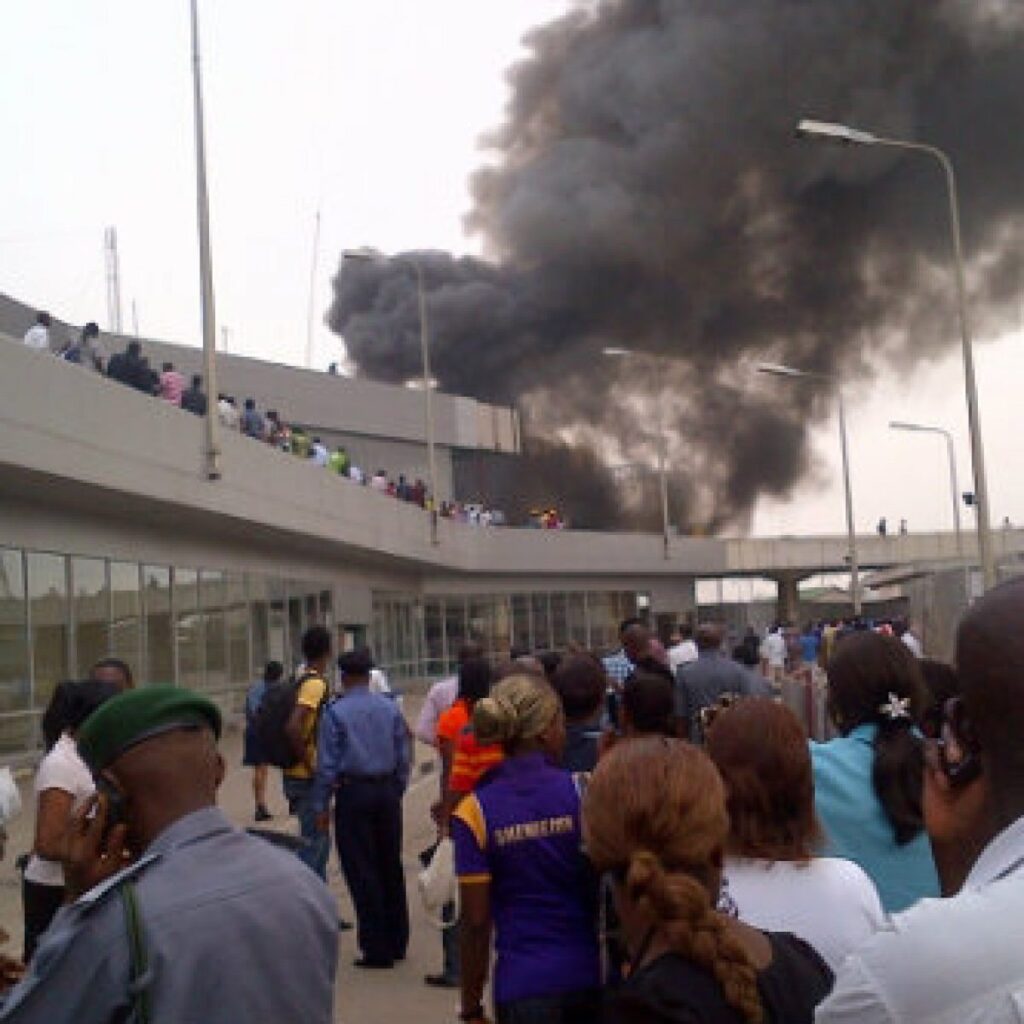
The President of the National Association of Aircraft Pilots and Engineers (NAAPE), Captain Bunmi Gindeh, has credited the decisive leadership of the Managing Director of the Federal Airports Authority of Nigeria (FAAN), Mrs. Olubunmi Kuku, with preventing what could have escalated into a major tragedy during Monday’s fire outbreak at the Old International Terminal of the Murtala Muhammed International Airport (MMIA), Lagos.
In a statement issued after the incident, NAAPE described the fire as a serious operational disruption that tested the resilience of Nigeria’s aviation system. However, the association noted that the structured and coordinated emergency response ensured the protection of lives, orderly evacuation of personnel, and gradual stabilisation of airport operations.
According to the association, airport authorities effectively handled multiple layers of crisis management, including the evacuation of staff from the control tower, rapid mobilisation of emergency responders, inter-agency coordination, medical attention for injured individuals, and the safe diversion of inbound international flights.
Gindeh said the response reflected preparedness rather than improvisation.
“What we witnessed was not confusion, but the execution of an established emergency system. The immediate activation of the Emergency Operations Centre, the protection of lives, structured evacuation, and orderly management of flight diversions demonstrate that FAAN had a functional crisis framework in place.
“Mrs. Olubunmi Kuku’s leadership ensured that a potentially tragic situation was stabilised with professionalism and clarity of command”, he stated.
He emphasised that in aviation, the true test of safety governance emerges during moments of operational stress.
“Airports are complex ecosystems. When critical infrastructure is affected, the ripple effects can be far-reaching — from air traffic control to passenger processing and airline schedules. The absence of fatalities and the progressive restoration of order reflect institutional discipline and coordinated crisis management”, he added.
NAAPE further noted that the temporary suspension of operations and diversion of some international flights were necessary precautionary steps that prioritised safety over convenience, describing such measures as hallmarks of responsible aviation management.
The association commended FAAN’s multi-agency collaboration involving firefighting units, security agencies, medical teams, and technical personnel, whose combined efforts contained the outbreak and secured the affected terminal.
While investigations into the cause of the fire continue and structural integrity assessments are ongoing, NAAPE called for sustained investment in infrastructure modernisation, redundancy systems, and regular emergency simulation exercises across Nigeria’s airports.
Gindeh reaffirmed the association’s commitment to constructive engagement within the aviation sector.
“Incidents like this remind us that preparedness must be continuous. Emergency planning must not be theoretical but operational. The aviation community must now consolidate lessons learned and further strengthen resilience at our national gateway”, he said.
NAAPE expressed solidarity with FAAN management, airport workers, airline operators, and passengers affected by the disruption, voicing confidence that full operational normalcy will follow comprehensive technical reviews and remedial actions.