


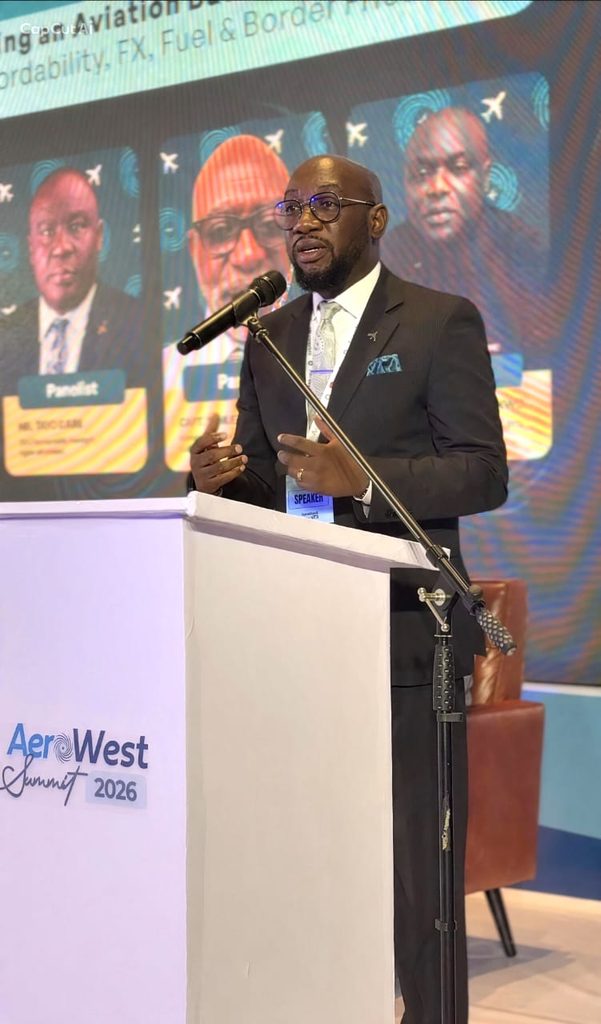
The Chief Commercial Officer of United Nigeria Airlines (UNA), Adedayo Olawuyi, has called for urgent reduction in aviation charges and taxes, saying the high cost of operating in Nigeria is ultimately passed on to air travellers.
Olawuyi made the call while speaking as a panelist at the AeroWest Conference in Lagos on Wednesday, during a session titled “The Real Cost of Running Aviation Business: Fixing Connectivity, Affordability, FX, Fuel and Border Friction.”
He said lowering aviation charges and taxes would provide a critical intervention towards making air travel more affordable, stressing that the financial pressures confronting domestic carriers extend beyond ticket pricing.
According to him, airlines face a fundamental mismatch between their revenues and expenditure, as tickets are largely sold in naira while a substantial proportion of their major operating costs are denominated in foreign currency.
He said the situation puts considerable pressure on airlines’ finances and limits their ability to maintain affordable fares while remaining commercially viable.
“How many of you would take a loan of 30 per cent to invest in a business that gives you less than five per cent profit? That is a pressing issue for airlines in Africa, specifically in Nigeria, the cost of financing”, Olawuyi said.
He identified the cost and availability of skilled manpower as another challenge confronting airlines, particularly the shortage of pilots.
“Consider the cost of training a pilot. Pilots today are in high demand and are not cheap to come by. We have airlines in this country with grounded aircraft because there are no pilots available”, he said.
Olawuyi also highlighted the absence of adequate Maintenance, Repair and Overhaul (MRO) facilities in the region, which he said forces Nigerian airlines to spend scarce foreign exchange abroad.
“Consider maintenance: we have to send aircraft abroad because we do not have MROs in this region. We are also spending on simulator training for pilots, meaning we earn naira but spend USD”, he explained.
The UNA executive said the sharp increase in aviation fuel prices had further compounded the financial burden on carriers and contributed to higher ticket prices.
He noted that airlines moved from purchasing aviation fuel at about ₦900 per litre in December 2025 to around ₦3,000 in 2026, describing the increase as a major escalation in operating costs.
According to him, airlines have absorbed significant portions of these rising expenses, but there is a limit to how much operators can cut without affecting the sustainability and safety of their operations.
“All of that must be covered. Why? Because safety must be paramount. While we are discussing connectivity as a solution to the problems we see today, it is not just the airlines alone that can solve the problem. Government needs to create an enabling environment for us”, Olawuyi said.
He said the aviation industry was often viewed primarily as a source of revenue by various stakeholders, without sufficient consideration of the financial pressures involved in keeping airlines operational.
“We all focus on making money from airlines. As my boss says, the airline is the goose that lays the golden egg, and everybody wants a piece of it. But at the end of the day, if the goose dies, everything is lost”, he said.
Olawuyi therefore called for greater collaboration among government, regulators, airlines, tourism operators and other stakeholders to address the structural problems affecting connectivity and affordability.
“There is not a single part of this puzzle that can be fixed by just one person. The government cannot fix it alone, the regulators cannot fix it alone, and the airlines themselves cannot fix it alone”, he said.
He noted that improved air connectivity was also crucial to tourism and business across West and Central Africa, stressing the need for stakeholders to work together to make regional travel more accessible.
“In the room today, we have tourism operators. You need connectivity to travel for business. So, all we are saying is that there has to be cooperation among all these stakeholders to improve connectivity within West and Central Africa”, he said.
On the commercial realities of airline operations, Olawuyi said carriers must balance connectivity ambitions with the need to remain financially sustainable.
“Every airline is set up to make money. I would not operate a route today where I cannot sustain operations,” he pointed out.
He explained that the region’s aviation market contains several low-demand routes, making aircraft selection critical to airline profitability.
“West Africa has many thin routes. Airlines must consider different aircraft sizes and types that will help them remain profitable on every sector they fly. It becomes challenging to operate on thin markets with an aircraft like a 737 when the maximum number of passengers available on that route is only four,” the CCO said.