


Stakeholders in Nigeria’s transport sector have raised fresh concerns over the country’s fragmented transportation system, warning that inefficiencies across road, rail, air, and maritime networks continue to undermine economic growth, trade expansion, and national productivity.
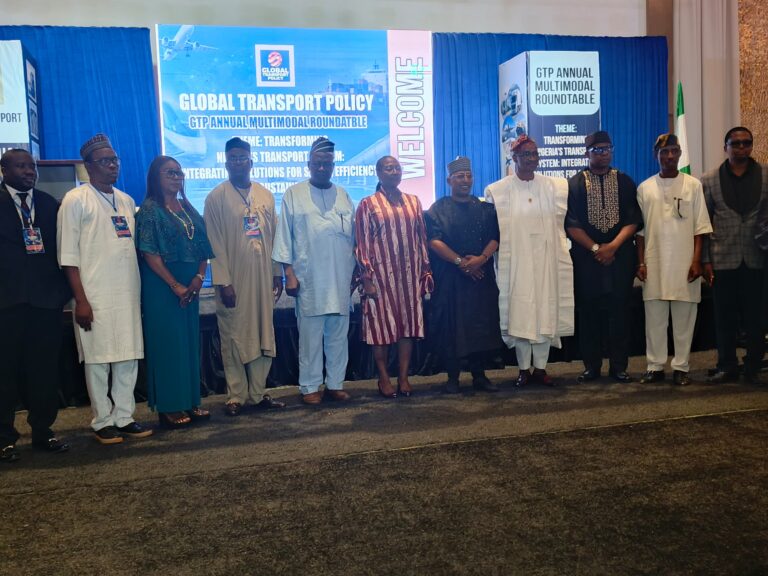
This formed the crux of discussions at the 2026 Annual Global Transport Policy (GTP) Multimodal Roundtable held in Ikeja, Lagos, where industry leaders, policymakers, and development partners called for urgent reforms to integrate the nation’s transport architecture.
In his opening remarks, the Chairman of the roundtable, Air Commodore (Rtd) Ademola Onitiju, emphasised that Nigeria’s transport systems, though critical to economic development, still operate in silos rather than as a unified network. He noted that poor coordination across transport modes has resulted in congestion, environmental strain, and significant productivity losses.
“Transportation is more than just movement from point A to point B. It is the lifeblood of economic growth and social inclusion”, he said, stressing that the absence of integration continues to limit accessibility, especially in underserved communities.
He highlighted that despite Nigeria’s strategic advantage of possessing all four major transport modes—road, rail, air, and waterways – planning and operations remain largely disconnected.
According to him, road infrastructure is often developed without rail linkages, while urban transit systems fail to connect effectively with rural areas.
The Chairman further pointed out that inefficiencies in multimodal transport management cost the economy billions annually, calling for a coordinated framework that aligns infrastructure, policy, and technology.
He also referenced recent global disruptions, including tensions around the Strait of Hormuz, as evidence of the growing importance of resilient and well-integrated transport systems in sustaining global and domestic logistics.
Complementing this position, the Chief Operating Officer of Global Transport Policy, Onoruoiza Mark Onuchi, in a keynote presentation titled “Multimodality in Motion: From Conversation to Transformation”, underscored the economic cost of Nigeria’s transport inefficiencies.
He revealed that logistics costs in Nigeria account for approximately 25 percent of GDP, with inefficiencies pushing total freight and logistics expenses to as much as 45 percent of trade value – far higher than the 5 to 10 percent recorded in more efficient economies.
Onuchi further noted that intra-African trade remains between 15 and 22 percent, significantly below Europe’s 60 percent and Asia’s 40 percent, attributing the gap largely to poor transport connectivity and weak multimodal systems.
“Multimodality is not a buzzword. It is the difference between trade that crawls and trade that scales”, he said.
He explained that Global Transport Policy, established in 2022, is driving efforts to bridge these gaps through a three-pronged approach comprising policy research and publication, capacity development through its academy, and consultancy services for transport infrastructure and strategy.
According to him, the organisation is working to transform dialogue into tangible outcomes by promoting integrated transport systems that connect ports to hinterlands, rail to road networks, and aviation to market access corridors.
Onuchi also announced plans to expand the roundtable into a continental platform, bringing in global institutions such as development banks and multilateral agencies, while introducing exhibitions to showcase practical solutions, technologies, and investment models.
Both speakers stressed that achieving an integrated transport system would require strong collaboration between government, private sector players, and international partners.
They identified key priorities to include policy harmonisation across transport modes, adoption of digital technologies for real-time coordination, embedding sustainability into transport planning, and ensuring equitable access to mobility.
The roundtable also issued a call for increased private sector participation and public-private partnerships to accelerate infrastructure development and policy implementation.
As part of its broader agenda, Global Transport Policy announced upcoming initiatives, including a Women in Transport programme aimed at promoting gender inclusion in the sector, and a student-focused career summit designed to build a pipeline of future transport professionals.
Stakeholders agreed that without urgent reforms, Nigeria risks missing out on the full benefits of the African Continental Free Trade Area (AfCFTA), which depends heavily on efficient and interconnected transport systems.
The consensus at the event was clear: moving Nigeria’s transport sector from fragmentation to integration is no longer optional but essential for unlocking trade, boosting productivity, and positioning the country as a competitive player in the global economy.