



The Apapa Area Command of the Nigeria Customs Service (NCS) has recorded its highest monthly revenue collection in history, generating ₦323 billion in July 2026.
The milestone reinforces the Command’s impressive revenue trajectory under the leadership of Comptroller Emmanuel Oshoba, who previously guided the nation’s busiest port command to a then-record collection of ₦304 billion in October 2025.
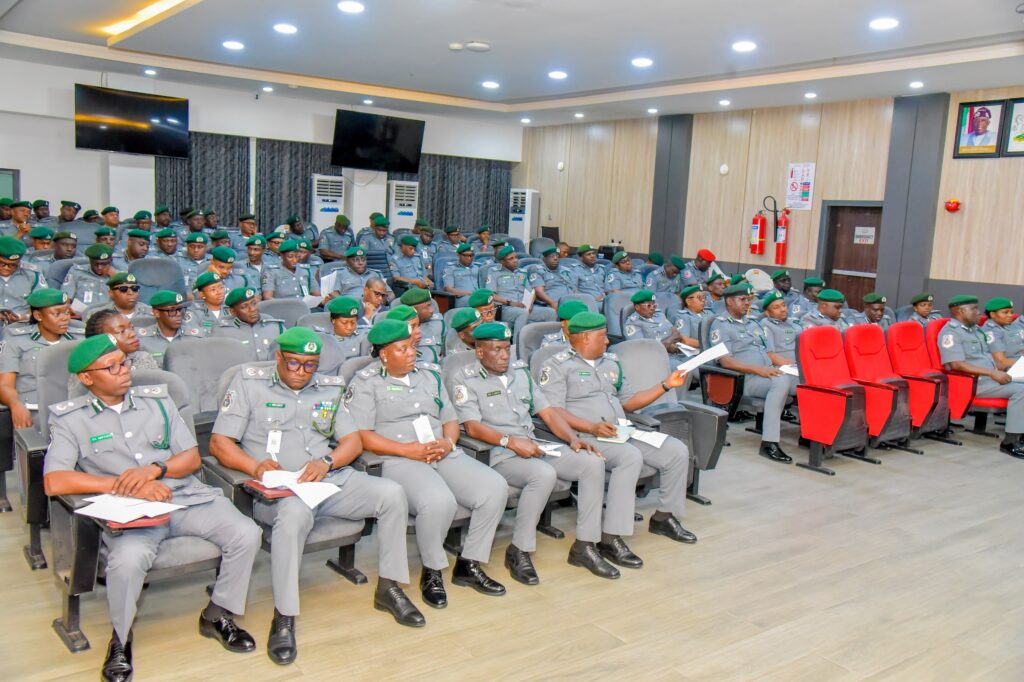
Oshoba disclosed the latest achievement during a monthly meeting with Deputy Comptrollers of Terminals and Unit Heads held on Tuesday, August 11, 2026.
According to him, the record-breaking performance reflects the combined impact of policy support, operational reforms and improved compliance among importers and other stakeholders operating within the Command.
He praised the Comptroller-General of Customs, Bashir Adewale Adeniyi, and the management of the Service for driving reforms that have transformed customs operations across the country.
“We recognise and acknowledge the CGC’s devotion and dedication to the modernisation project of the Nigeria Customs Service. The management team has introduced several innovations that have streamlined our activities and given us clear direction,” he said.
The Customs Area Controller explained that ongoing reforms have already begun to deliver tangible results, particularly through the improved performance of the B’Odogwu platform.
He noted that although the indigenous customs management system encountered initial challenges, subsequent improvements have significantly enhanced its efficiency and contributed to the Command’s strong revenue performance.

Oshoba also identified the One-Stop Shop initiative as another major contributor to the impressive revenue growth, noting that it has reduced cargo clearance time and created a more predictable trading environment for legitimate businesses.
He further highlighted the impact of the Authorised Economic Operator framework, revealing that more than 200 operators are currently benefiting from the programme.
“Another important development is the Authorised Economic Operator framework, which currently has more than 200 beneficiaries. This has positively impacted the revenue profile of the Command”, he said.
The Area Controller added that intelligence-led enforcement operations have strengthened compliance, with officers intensifying efforts to identify false declarations and ensure adherence to the Service’s valuation principles.
He also attributed part of the success to the business environment created by President Bola Ahmed Tinubu, particularly the relative stability in the foreign exchange market.

According to him, a more predictable exchange rate regime has enabled importers and other business operators to plan more effectively, make informed decisions and conduct transactions with greater confidence.
Beyond revenue generation, Oshoba challenged officers to evaluate their individual contributions to the Command’s overall performance.
“In your Area of Responsibility, you must ask yourself, apart from the normal revenue generated by your Unit, what is your own contribution in terms of intervention? What have I added”? he asked.
He stressed the importance of trade facilitation and ease of doing business, describing the current operating environment as more stable and supportive of economic growth.
The Customs chief directed officers to ensure that disputes are resolved promptly and that consignments requiring additional scrutiny are handled in line with established documentation procedures and the Post Clearance Audit framework.

On stakeholder engagement, he urged personnel to continue building stronger relationships through professionalism, collaboration and mutual respect.
“When you interact with stakeholders, let us always create a positive impact. Let people who come into your office leave with hope rather than despair”, Osoba advised.
He also called for greater transparency, discipline and continuous learning, encouraging officers to remain abreast of emerging digital processes and seek guidance from more experienced colleagues whenever necessary.
Describing leadership as a collective responsibility, Oshoba urged Staff Officers to work closely with Deputy Controllers to promote discipline and create a work environment built on teamwork, empathy and concern for staff welfare.
He further emphasised the need for heightened security awareness, effective supervision and continuous in-house training, directing all units to sustain the current momentum and remain committed to productivity and quality service delivery.
While commending officers and compliant stakeholders for contributing to the historic revenue performance, Oshoba urged them not to become complacent but to regard the achievement as a foundation for even greater accomplishments before the end of 2026.