


Delta Air Lines has taken another major step in its push towards cleaner air travel with the completion of a new sustainable aviation fuel (SAF) blending facility in Minnesota, a project expected to expand the availability of low-carbon aviation fuel at Minneapolis-St. Paul International Airport (MSP), the airline’s second-largest hub.
The new facility, located at Flint Hills Resources’ Pine Bend Refinery, will blend sustainable aviation fuel with conventional jet fuel before delivering it through existing pipeline infrastructure to MSP, where Delta consumes about 250 million gallons of jet fuel annually.
Designed to blend up to 30 million gallons of neat SAF each year, the project strengthens the infrastructure needed to accelerate the adoption of cleaner aviation fuel across one of Delta’s busiest operations.
The blending facility is the latest achievement under the Minnesota SAF Hub, an industry coalition launched in 2023 by Delta, Greater MSP Partnership, Bank of America, Ecolab and Xcel Energy to establish Minnesota as a leading centre for sustainable aviation fuel production and distribution. Delta and Flint Hills Resources first unveiled plans for the project in September 2024.
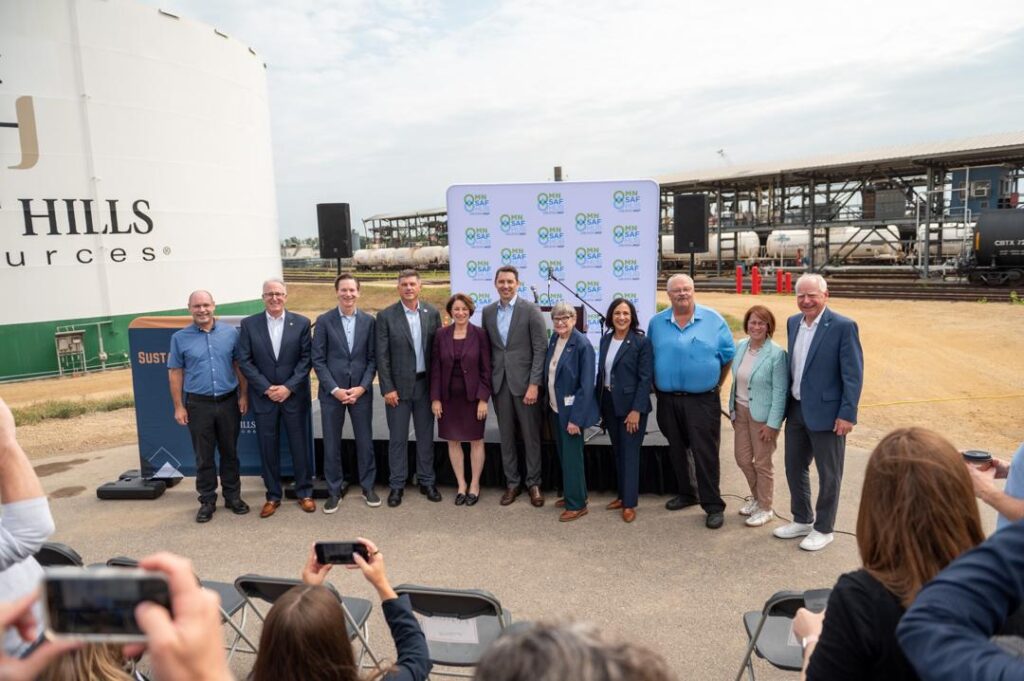
Delta President Peter Carter joined executives from Flint Hills Resources, Ecolab and Greater MSP, alongside U.S. Senator Amy Klobuchar, Minnesota Governor Tim Walz, Congressman Brad Finstad, Speaker Lisa Demuth, Senator Ann Rest and other government and industry leaders to commission the facility.
Describing the project as a landmark achievement, Carter said the facility reflects a shared commitment to position Minnesota at the forefront of sustainable aviation fuel development.
“This facility is the culmination of a shared vision for Minnesota to become a leader in sustainable aviation fuel”, Carter said.
“By expanding the infrastructure needed to support broader SAF adoption, it represents an important step toward turning that potential into reality.
“Delta is proud to be part of this effort and excited about the role Minnesota can play in advancing the future of sustainable aviation fuel”.
Sustainable aviation fuel is produced from renewable feedstocks and can significantly reduce lifecycle carbon emissions compared with conventional jet fuel.
It is compatible with today’s aircraft engines and can be transported through much of the existing fuel infrastructure, making it one of the aviation industry’s most promising pathways to reducing emissions.
Despite its potential, global SAF production remains limited, underscoring the need for continued investment in production capacity, supply chains and supporting infrastructure.
The Minnesota project complements Delta’s wider decarbonisation strategy, including its recently announced five-year collaboration with Shell Aviation to increase SAF availability across key U.S. hubs and priority cities, including Minneapolis-St. Paul, through 2030.
With jet fuel accounting for nearly 90 per cent of its carbon emissions, Delta is targeting 10 per cent SAF usage by 2030 as part of its long-term ambition to achieve net-zero emissions by 2050.