


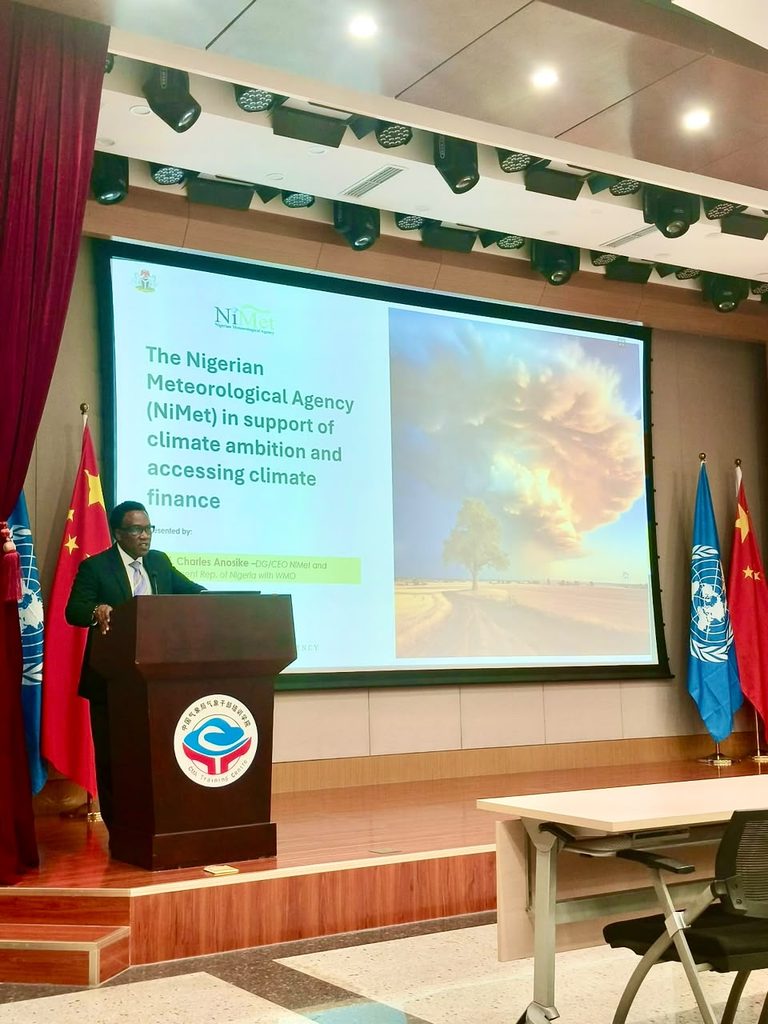
The Director-General of the Nigerian Meteorological Agency (NiMet), Prof. Charles Anosike, has joined meteorological and climate leaders from around the world at a high-level World Meteorological Organization (WMO) dialogue focused on strengthening the role of climate science in mobilising finance for climate action.
The High-level Dialogue on Climate Science Information for Climate Finance, held in Beijing, China, from September 14 to 18, 2026, brought together senior officials to examine how National Meteorological and Hydrological Services (NMHSs) can play a stronger role in securing climate finance and translating scientific information into practical climate resilience measures.
The dialogue was held alongside the 53rd Senior Official Field Exchange (SOFE), providing participants with an opportunity to examine China’s approach to meteorological early warning and disaster risk reduction.
Focus On Climate Finance
Discussions at the high-level dialogue centred on strengthening the leadership capacity of NMHSs to mobilise climate finance and positioning meteorological and hydrological services to contribute more effectively to climate investment decisions.
Participants also examined ways of aligning scientific and technical capabilities with risk-informed, people-centred early warning systems, while promoting stronger collaboration between meteorological institutions and multilateral financing organisations.
A major focus was the need to move beyond conventional technical assistance towards sustainable investment, with practical cooperation between national meteorological frameworks and climate-financing institutions identified as an important pathway.
The dialogue further considered how NMHS leaders can strengthen strategic thinking, develop productive partnerships and better position their institutions to access and deploy resources for climate resilience.
China Showcases AI-Driven Early Warning Platform
Held back-to-back with the high-level dialogue, the 53rd SOFE took participants to Fujian Province for first-hand exposure to China’s implementation of the Multi-hazard, Alert, Zero-gap and Universal (MAZU) platform.
The AI-driven meteorological early warning solution supports the WMO’s Early Warnings for All (EW4All) initiative and is designed to strengthen disaster preparedness and risk reduction.
The field exchange provided opportunities for technical exchanges, field visits and peer learning, allowing senior meteorological officials to examine practical approaches to multi-hazard early warning and disaster risk management.
Anosike’s participation places Nigeria within the international exchange on how meteorological and hydrological services can move beyond weather forecasting to become stronger partners in climate finance, early warning systems and climate resilience.
The engagement also provided an opportunity for Nigeria to draw lessons from international practices in deploying technology, strengthening institutional partnerships and connecting climate science with investment and disaster-risk reduction strategies.