


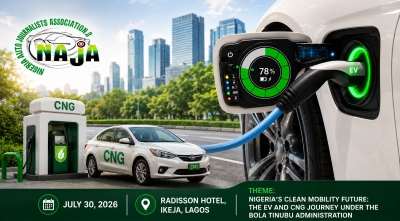
Top stakeholders across Nigeria’s automotive and energy sectors are set to converge in Lagos on July 30, 2026, for the 3rd Nigeria Auto Journalists Association (NAJA) Auto Summit, a high-level forum focused on accelerating the country’s transition to cleaner, more affordable transportation.
Scheduled to hold at the Radisson Hotel, Ikeja, the summit is themed: “Nigeria’s Clean Mobility Future: The EV and CNG Journey Under the Bola Tinubu Administration’. The event is expected to draw policymakers, regulators, vehicle manufacturers, energy providers, transport operators, financiers, and industry experts.
Organisers said the summit will serve as a strategic platform to evaluate Nigeria’s progress in adopting Electric Vehicles (EVs) and Compressed Natural Gas (CNG) vehicles, while also addressing the challenges and opportunities shaping the country’s evolving mobility landscape.
Chairman of NAJA, Theodore Opara, noted that the initiative is geared towards delivering practical solutions that can reduce transportation costs, enhance energy security, and stimulate economic growth.
He emphasised that Nigeria’s vast natural gas reserves present a viable pathway for cleaner mobility through expanded CNG infrastructure, which could also help reduce dependence on foreign exchange for fuel imports.
Opara stressed the importance of collaboration among government institutions, automakers, financial bodies, and transport operators in achieving a sustainable and affordable transportation system nationwide.
The summit will feature key speakers including the Chairman of the Presidential Initiative on Compressed Natural Gas and Electric Vehicles, Barrister Ismael Ahmed; Director-General of the National Automotive Design and Development Council (NADDC), Joseph Osanipin; and the Corps Marshal of the Federal Road Safety Corps (FRSC), Shehu Mohammed, alongside other public and private sector leaders.
Discussions will centre on critical areas such as policy implementation, infrastructure development, financing frameworks, safety standards, local vehicle assembly, investment prospects, and consumer adoption strategies.
The event comes amid growing momentum for alternative fuels in Nigeria, driven by the removal of fuel subsidies and increased government backing for EV and CNG initiatives.
According to organisers, the summit will also spotlight the need to expand charging networks and CNG refuelling infrastructure, while leveraging media platforms to boost public awareness and acceptance of clean mobility solutions.
Chairman of the Summit Planning Committee, Rasheed Bisiriyu, said participants would present real-world case studies from ongoing EV and CNG projects and outline strategies to tackle persistent challenges such as high vehicle costs, limited infrastructure, and technical capacity gaps.
He added that building a strong EV and CNG ecosystem could significantly reduce logistics costs, improve mobility, and ease pressure on Nigeria’s foreign exchange reserves.
Government incentives alone will not guarantee success. Investment in charging stations, CNG conversion centres, maintenance facilities and technical training will determine how quickly adoption can scale nationwide,” he explained.
With rising public interest and expanding policy support, the 3rd NAJA Auto Summit is expected to chart a clear roadmap for Nigeria’s clean mobility future and drive the push toward a more sustainable and cost-effective transport system.