



… Oyetola unveils gazetted law, logo; orders transition from Shippers’ Council to new agency
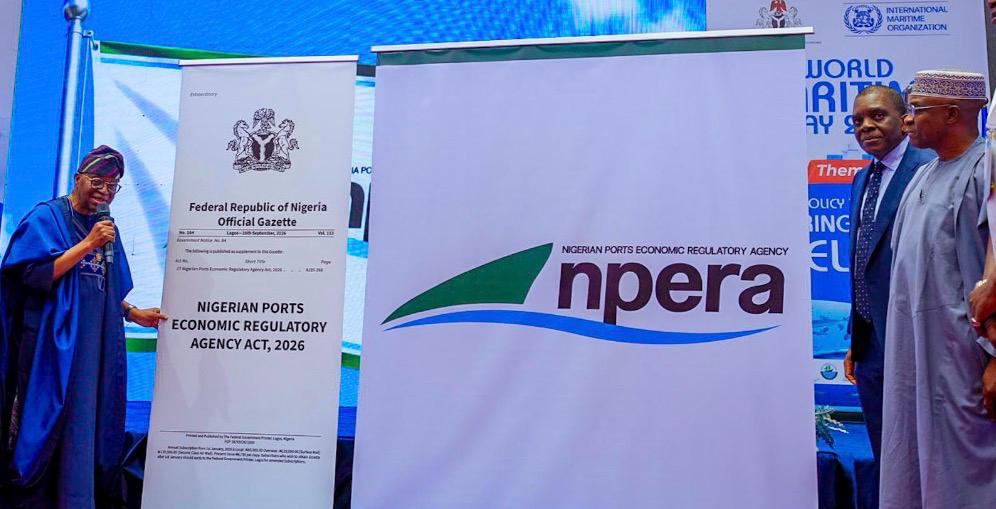
Nigeria’s efforts to address port charges, strengthen regulatory independence and improve the competitiveness of its maritime industry have entered a new phase with the unveiling of the gazetted Nigeria Ports Economic Regulatory Agency (NPERA) Act, 2026.
The Minister of Marine and Blue Economy, Dr. Adegboyega Oyetola, who unveiled the Act alongside the agency’s official logo on Friday in Lagos, described the development as a significant milestone in the country’s drive to establish a substantive legal framework for port economic regulation after nearly two decades of efforts.
The new law is expected to provide a statutory foundation for regulating port tariffs and charges, promoting fair competition, enforcing service standards, resolving commercial disputes and protecting the interests of port users.
Its unveiling comes amid ongoing efforts to modernise Nigeria’s ports, attract private investment, improve service delivery and position the country as a competitive maritime and logistics hub in West and Central Africa.
Speaking at the Third Quarter 2026 Citizens’ and Stakeholders’ Engagement of the Federal Ministry of Marine and Blue Economy in Victoria Island, Lagos, Oyetola said the enactment of the law, following President Bola Ahmed Tinubu’s assent in June 2026, had established the legal basis for a dedicated port economic regulatory agency.
The engagement, themed “Building Strategic Bilateral Partnerships for Sustainable Growth, Investment, and Technology of Nigeria’s Marine and Blue Economy”, brought together government officials, industry operators, investors, development partners and other stakeholders to discuss reforms and investment opportunities in the sector.
Why the NPERA Act Matters
The establishment of NPERA marks a major development in Nigeria’s efforts to strengthen economic oversight of its port system.
For years, the Nigerian Shippers’ Council has performed the role of port economic regulator, having assumed the responsibility on an interim basis in 2014.
The enactment of the NPERA Act now provides a statutory framework for transferring that function to a dedicated agency.
The transition is significant because port efficiency depends not only on physical infrastructure, cargo-handling capacity and maritime security but also on the transparency of charges, fairness of commercial arrangements and effectiveness of regulatory oversight.
Port users, including shipping companies, freight forwarders, importers, exporters and other businesses involved in cargo movement, depend on a predictable regulatory environment to plan operations and manage costs.
Where tariffs and charges are insufficiently transparent, or commercial disputes are not resolved efficiently, the resulting uncertainty can increase the cost of doing business and undermine confidence in the port system.
An effective economic regulator is therefore expected to provide a framework for overseeing port-related charges, encouraging competition among service providers, monitoring service standards and ensuring that the interests of port users are taken into account.
For Nigeria, these functions are particularly important as the country seeks to improve the attractiveness of its ports to regional cargo owners and international shipping operators.
The effectiveness of the new agency, however, will depend on how its statutory responsibilities are implemented, the strength of its institutional independence and its ability to enforce applicable regulations consistently.
Oyetola Orders Transition to New Agency
As part of the process of operationalising NPERA, Oyetola disclosed that he had directed the immediate constitution of a ministerial committee to oversee the transition of the Nigerian Shippers’ Council, which has served as the interim port economic regulator since 2014, into the new agency.
The committee is expected to oversee the transition arrangements necessary to establish the new regulatory institution.
The minister stressed that the credibility of an economic regulator depended substantially on its independence, impartiality and freedom from responsibilities that could create actual or perceived conflicts of interest.
“The credibility of an economic regulator rests, in no small measure, on its independence, impartiality and freedom from responsibilities that could give rise to actual or perceived conflicts of interest”, he said.
He consequently directed the agency to operate as an impartial arbiter, free from competing regulatory and operational responsibilities.
The directive underscores the importance of ensuring that the new institution can discharge its responsibilities without undue influence from the interests it is expected to regulate.
For port users and investors, a regulator that applies established rules consistently can help reduce uncertainty, provide a framework for resolving commercial disagreements and improve confidence in the administration of port-related economic activities.
The transition from the Shippers’ Council’s interim arrangement to the new agency will therefore be an important test of the government’s commitment to establishing an effective and independent port economic regulatory system.
Port Modernisation to Complement Regulatory Reform
Beyond the establishment of NPERA, the minister highlighted the Federal Government’s plans to modernise existing ports across the country, including Apapa, Tin Can Island, Onne, Rivers, Delta and Calabar.
He said the programme was designed to ensure balanced development of the national port system, rather than concentrating improvements in Lagos.
“No part of our national port system will be left behind in this modernisation programme”, Oyetola declared.
He added that ports outside Lagos were equally important to Nigeria’s economic future.
The emphasis on nationwide modernisation reflects the need to improve the capacity and operational efficiency of the country’s different port locations, particularly as Nigeria seeks to strengthen trade facilitation and expand economic opportunities across its coastal regions.
Modern infrastructure, efficient cargo handling, effective regulation and predictable port charges are interconnected elements of a competitive maritime industry.
While infrastructure upgrades can improve capacity and reduce operational bottlenecks, an effective economic regulatory framework is necessary to support transparent commercial practices and protect port users.
The combination of these measures is expected to support the development of a more efficient and competitive port system.
Six Deep Seaports Approved for Development
Oyetola also disclosed that the Federal Government had approved the development of six deep seaports at Ibom, Bakassi, Agge, Gateway, Ondo and Bonny.
The proposed facilities are intended to expand Nigeria’s maritime capacity and strengthen its position as a regional logistics hub.
The development of additional port facilities could create opportunities to distribute cargo traffic more widely, stimulate investment in coastal communities and support economic activities linked to shipping, logistics and international trade.
However, the benefits will depend on effective implementation, adequate supporting infrastructure, efficient connections to inland markets and a regulatory environment capable of supporting long-term investment.
The emergence of NPERA is therefore relevant to the broader port development programme, as economic regulation will be an important component of the framework governing port charges, competition and service standards.
As new facilities are developed and existing ones modernised, the agency will have a central role in the economic regulatory framework applicable to the port system, in accordance with its statutory mandate.
Maritime Security Gains Strengthen Port Competitiveness
The minister also highlighted improvements in Nigeria’s maritime security, reporting that the country had maintained zero piracy incidents in its territorial waters through the Deep Blue Project.
He described the lifting in August 2026 of the 12-year United States Coast Guard Condition of Entry imposed on vessels arriving from Nigeria as a significant achievement.
According to him, the development reflected progress in maritime security and compliance with the International Ship and Port Facility Security Code.
Maritime security is a critical component of port competitiveness because shipping operators consider the safety of vessels, cargoes and crew when making operational decisions.
Improvements in security can help strengthen confidence in Nigerian waters and support efforts to attract greater maritime activity.
However, security alone cannot determine the competitiveness of a port. The cost of port services, regulatory certainty, infrastructure, cargo-handling efficiency and the ease of doing business also influence the decisions of shipping lines and cargo owners.
The establishment of NPERA is intended to address the economic regulatory dimension of this broader competitiveness agenda.
Together, effective security arrangements, modern infrastructure and credible economic regulation are important to Nigeria’s ambition to strengthen its role in regional and international maritime trade.
Government Moves to Accelerate Cabotage Vessel Financing Fund
Oyetola further reaffirmed the Federal Government’s commitment to indigenous shipping development, disclosing that he had directed the Nigerian Maritime Administration and Safety Agency (NIMASA) to work with approved Primary Lending Institutions to accelerate the processing and disbursement of the Cabotage Vessel Financing Fund to qualified applicants.
The directive is aimed at improving access to financing for eligible indigenous shipping operators.
Access to capital remains an important consideration in the development of a competitive domestic shipping industry, particularly for operators seeking to acquire vessels and expand their capacity to participate in coastal and inland maritime activities.
Accelerating the processing of eligible applications could help address delays in accessing the fund and support efforts to strengthen local participation in the maritime sector.
The initiative also aligns with the government’s broader objective of developing the marine and blue economy through investment, improved institutional performance and stronger domestic capacity.
International Partnerships to Support Blue Economy Development
On international cooperation, Oyetola cited Nigeria’s election to Category C of the International Maritime Organization Council in November 2025 and ongoing engagements with Denmark, India, Norway and the United Kingdom.
He said the government’s approach to international partnerships was focused on practical outcomes and the development of local capabilities.
“Our approach to international cooperation is purposeful and results-oriented”, he said, noting that partnerships must strengthen local capabilities and deliver measurable, sustainable outcomes.
The minister’s remarks highlighted the importance of international cooperation in areas such as maritime technology, skills development, investment, sustainable resource management and the adoption of practices that can improve the performance of Nigeria’s marine and blue economy.
At the engagement, the Ambassador of the Kingdom of Denmark to Nigeria, Jens Ole Bach Hansen, delivered a presentation titled “Denmark’s Experience in Building a Sustainable Blue Economy: Lessons for Strategic Partnerships, Investment and Technology Transfer with Nigeria”.
The presentation focused on Denmark’s experience and the potential lessons for Nigeria in developing strategic partnerships, attracting investment and facilitating technology transfer.
Such partnerships could provide opportunities for knowledge exchange and technical cooperation, particularly in areas where international experience can support Nigeria’s maritime development objectives.
Implementation Will Determine Impact of NPERA Act
With the unveiling of the gazetted NPERA Act and its official logo, attention will now turn to the institutional transition and the agency’s ability to translate its statutory responsibilities into practical improvements across the port system.
The law establishes the foundation for a dedicated port economic regulator, but its impact will ultimately be measured by how effectively the agency performs its duties.
Key expectations include transparent oversight of port tariffs and charges, fair treatment of port users, effective resolution of commercial disputes, consistent enforcement of service standards and the promotion of competition within the applicable regulatory framework.
Its operational independence will also be important in ensuring that regulatory decisions are based on established rules and the interests of an efficient, competitive port system.
For importers, exporters, shipping companies, freight forwarders and other port users, the central question will be whether the new regulatory arrangement delivers greater predictability, accountability and fairness in the cost and administration of port services.
The government’s parallel commitment to modernising existing ports, developing new deep seaports, improving maritime security and supporting indigenous shipping provides a broader context for the agency’s establishment.
Ultimately, the success of the NPERA Act will depend not simply on its enactment or unveiling, but on the strength of the institution established under it and the measurable improvements it delivers to Nigeria’s maritime industry.
The law represents a new phase in the country’s port reform agenda, with the challenge now being to turn its provisions into effective regulation that supports trade, investment and a more competitive maritime economy.