


The Federal Government and the Nigerian Maritime Administration and Safety Agency (NIMASA) have intensified calls for increased participation of women in Africa’s maritime industry, declaring that gender inclusion is critical to unlocking the continent’s blue economy potential and driving sustainable economic growth.
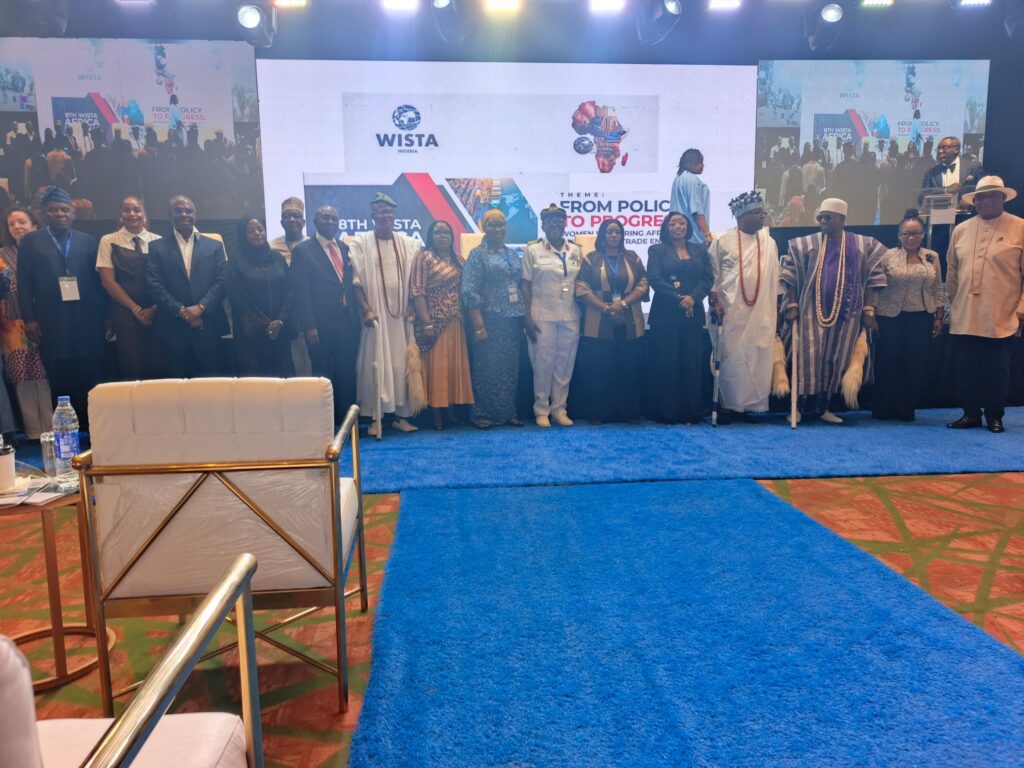
The renewed commitment was made at the 8th Women in Shipping and Trading Association (WISTA) Africa Regional Conference held in Lagos, where government officials, maritime regulators, industry leaders and development partners gathered to chart a new course for women’s advancement in the sector.
Representing the Minister of Marine and Blue Economy, the Director of Planning, Research and Statistics, Hajia Kaltum Ibrahim, said Nigeria’s blue economy agenda under President Bola Tinubu is deliberately designed to place women and young people at the centre of the country’s maritime transformation.
Speaking on the conference theme, “From Policy to Implementation: Women Advancing Africa’s Blue Economy,” Ibrahim said the true success of Africa’s blue economy would not be measured by the quality of policies alone but by the ability to translate them into practical outcomes that create jobs, attract investments and improve livelihoods.
She disclosed that the Federal Ministry of Marine and Blue Economy has developed a comprehensive National Policy on Marine and Blue Economy to provide a strategic framework for the sustainable development of Nigeria’s maritime resources while promoting environmental sustainability, economic competitiveness and social inclusion.
According to her, the policy prioritises strategic public-private partnerships to stimulate investment, innovation, infrastructure development and value creation across the maritime ecosystem.
“Sustainable growth cannot be achieved through infrastructure and capital alone. It must also be driven by people”, she said.
Ibrahim stressed that the policy places significant emphasis on expanding opportunities for women and youths through capacity development, entrepreneurship, leadership and skills acquisition across shipping, ports, logistics, fisheries, marine science, offshore industries and maritime administration.
She noted that empowering women is not simply a matter of equity but a strategic economic necessity capable of strengthening decision-making, expanding the industry’s talent pool and improving institutional competitiveness.
While acknowledging the growing contributions of women as ship owners, maritime lawyers, academics, marine scientists and business leaders, she said institutional barriers still limiting women’s participation must be dismantled.
She commended WISTA for its advocacy, mentorship and professional development initiatives, describing the association as a strategic partner in building a more inclusive and globally competitive maritime sector.
Calling for stronger collaboration across Africa, Ibrahim urged participants to ensure the conference delivers concrete outcomes.
“Let this conference be a catalyst for action. Let us move beyond dialogue to measurable accomplishments by building stronger partnerships, investing in people and creating practical pathways that will enable more women to lead Africa’s maritime transformation”, she said.
Also speaking, the Director-General of NIMASA, Dr. Dayo Mobereola, reaffirmed the agency’s commitment to promoting gender inclusion, revealing that the majority of the agency’s directors are women who attained their positions strictly on merit.
He described women as focused, determined and result-oriented professionals whose capabilities remain underutilised within the maritime industry.
“It is quite unfair that women are not taking major roles in the maritime industry. To have a thriving blue economy, we need to put women in the right places”, Mobereola said.
He praised WISTA Africa for choosing Nigeria to host the conference and urged the association to sustain its focus on job creation, innovation and sustainable development.
The NIMASA boss pledged the agency’s continued support for WISTA and initiatives that promote women’s advancement in the maritime sector, noting that organisations like WISTA are indispensable partners in achieving industry growth and development.
He also highlighted the growing impact of women across the maritime value chain as ship owners, marine lawyers and other professionals, insisting that deliberate efforts must be made to move from policy discussions to practical actions that expand opportunities for women.
The conference attracted participants from across Africa, including government representatives, maritime administrations, international organisations, development institutions and members of the global WISTA network, all united in advancing an inclusive and sustainable blue economy for the continent.