



By Daphne Uduneje
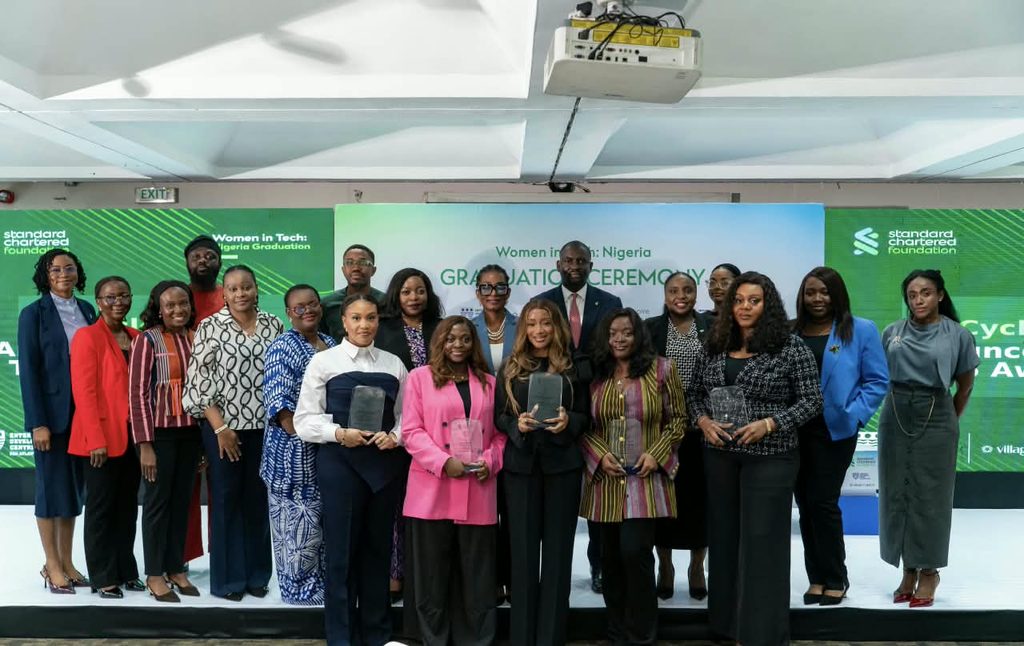
The Enterprise Development Centre (EDC) of Pan-Atlantic University, in partnership with the Standard Chartered Foundation and Village Capital, has graduated 11 women-led businesses from the seventh cohort of its Women in Tech Incubator and Accelerator Programme, reinforcing efforts to equip female entrepreneurs with the skills, funding and business structures required to scale in Nigeria’s increasingly digital economy.
The graduation ceremony, held at The Wheatbaker Hotel, Ikoyi, Lagos, marked the completion of the latest cycle of the programme and its seventh year of supporting women-owned technology and technology-enabled businesses across Nigeria.
The 11 graduands emerged from a five-to-six-month programme that combined capacity building, mentoring, coaching and specialised business advisory services, with particular emphasis on helping participants strengthen their business models, corporate governance and readiness for funding.
The latest cohort brings the number of women directly supported by the programme since its launch in 2019 to 60, with beneficiaries building businesses and technology solutions across sectors including education, healthcare, fashion, wellness and supply chain management.
For the organisers, however, the graduation represents more than the completion of an entrepreneurship programme. It marks another stage in efforts to move women-led businesses from early-stage ventures into structured enterprises capable of attracting capital, expanding operations and creating wider economic impact.
Speaking at the ceremony, the Director, Enterprise Development Centre, Pan-Atlantic University, Dr. Nneka Okekearu, said the programme had continued to evolve in response to changes in the economic and technology landscape.
“When you empower a woman, you empower a nation. Over the last seven years, we have empowered numerous women in the tech and tech-enabled space,” Okekearu said.
She explained that this year’s programme introduced more specialised advisory services to address the changing needs of participating businesses.
“Every year we see changes economically, socially, and in the tech space. This year, we introduced more specialised advisory services,” she said.
Building Businesses Beyond Graduation
A major focus of the programme, according to Okekearu, is ensuring that businesses do not leave the programme with only entrepreneurial knowledge but also with the institutional structures required to operate and attract funding.
She said the programme helps participants establish corporate governance structures, including boards, while strengthening their financial literacy and discipline.
“We set up a board for each business to help them refine their model. When that is done, they become a magnet for funding. They have financial discipline, financial literacy, and all the structures funders require,” she said.
Beyond business advisory and mentoring, the programme provides seed grants and access to single-digit loan pools through its network.
Okekearu said participants are selected from businesses that are at least 51 per cent women-owned, technology-enabled and beyond the ideation stage.
She noted that the performance of previous cohorts provided evidence of the potential impact of the intervention, with several out growing revenues, pivoting their business models and receiving industry recognition.
“Many have grown their revenue, pivoted their business models, and won awards. It is not just about numbers, but impact in the lives of people and the communities they serve,” she said.
Graduates Addressing Real Market Problems
The businesses represented by the graduating cohort also demonstrate the range of challenges women entrepreneurs are tackling through technology.
Okekearu said some beneficiaries developed solutions based on problems they had personally experienced, including access to education and finance.
“We have a woman building a platform for children with learning disabilities. Another built a platform after watching her mother make over a million naira daily but couldn’t access funding because of a lack of documentation.
Women are building solutions from gaps and pains they have personally experienced,” she said.
According to her, the relationships built during the programme often continue after graduation, with mentors maintaining links with alumnae and supporting their businesses beyond their formal participation.
“The best time to be a woman entrepreneur is now,” she added.
Standard Chartered Celebrates Seventh Cohort
Also speaking at the graduation ceremony, the Head, Corporate Affairs, Brand and Marketing, Standard Chartered Nigeria, Mrs. Joke Adu, said the bank remained committed to advancing women’s economic inclusion.
Adu described the graduation as an important milestone in the seven-year partnership, noting that the programme had supported 60 women since 2019 and generated wider impact through their businesses.
“Today we are celebrating Cohort 7 of the Standard Chartered Foundation Women in Tech Incubator. We started in 2019 and have supported 60 women, impacting thousands,” she said.
She explained that the programme provides beneficiaries with training and business advisory support, while selected participants receive seed funding to scale their businesses.
Adu said the progress of programme alumnae demonstrates the contribution women-led enterprises can make to solving problems across key sectors of the economy.
However, she stressed that expanding the impact would require broader collaboration.
“We see significant progress every day. While we are proud of our contribution, there are opportunities for more organisations and government to collaborate and empower more women doing phenomenal work,” she said.
Women and Nigeria’s Technology Economy
The graduation also provided an opportunity to highlight the continuing gender gap in Nigeria’s technology ecosystem.
Delivering the keynote address, the Founder and Executive Director, Women’s Technology Empowerment Centre (W.TEC), Mrs. Oreoluwa Leshi, said increasing women’s participation in technology was critical to the country’s development.
“A nation cannot develop with just half of its population succeeding. Women are primary caregivers raising the next generation. Yet women make up only about 20 per cent of Nigeria’s tech
workforce,” Leshi said.
She said initiatives that provide women-led startups with access to advice, mentorship and funding were important to enable more women to participate meaningfully in the technology economy.
‘The Programme Gave Me Clarity’
For the newly graduated entrepreneurs, the completion of the programme represented an important step in refining their businesses and preparing for the next phase of growth.
One of the graduands, Mrs. Fara Popoola, Founder and CEO of Check It Limited (Proctor 360), said the programme helped her move from pursuing multiple products and customer segments to developing a more focused business proposition.
Proctor 360 is a platform designed to help wholesalers protect trade during import and export transactions.
“Three months ago, I was all over the place with multiple products and customer segments. This programme helped me focus on my ideal customer and how to serve them,” Popoola said.
She said winning the grant would enable the company to deploy field agents and expand into the informal market.
“Winning this grant allows us to deploy field agents and reach the informal market that needs us most,” she added.
For Popoola, the programme’s impact went beyond business strategy and funding, helping to build the confidence required to pursue her entrepreneurial ambitions.
“This has given me boldness and clarity of vision. Women tend to stay indoors, afraid to step out. We need more of this, and I intend to pass it on,” she said.
With the graduation of the 11 businesses, the seventh cohort now joins the programme’s growing alumni network, bringing the total number of directly supported women to 60 since inception.
As the initiative enters its eighth year, the focus for the newly graduated businesses will shift from structured support within the programme to execution, market expansion, fundraising and sustainable growth — the next test of whether the capabilities and networks built during the programme can translate into enduring enterprises and wider economic impact.