


The proposed connection will link Lagos Airport’s three terminals to the Red Line, improving passenger access and connecting cargo facilities to the city’s rail network.
Financing discussions for a proposed rail connection between Murtala Muhammed International Airport (MMIA), Lagos, and the Lagos Mass Transit Red Line have reached an advanced stage, raising prospects of improved connectivity between Nigeria’s busiest airport and the city’s public transport network.
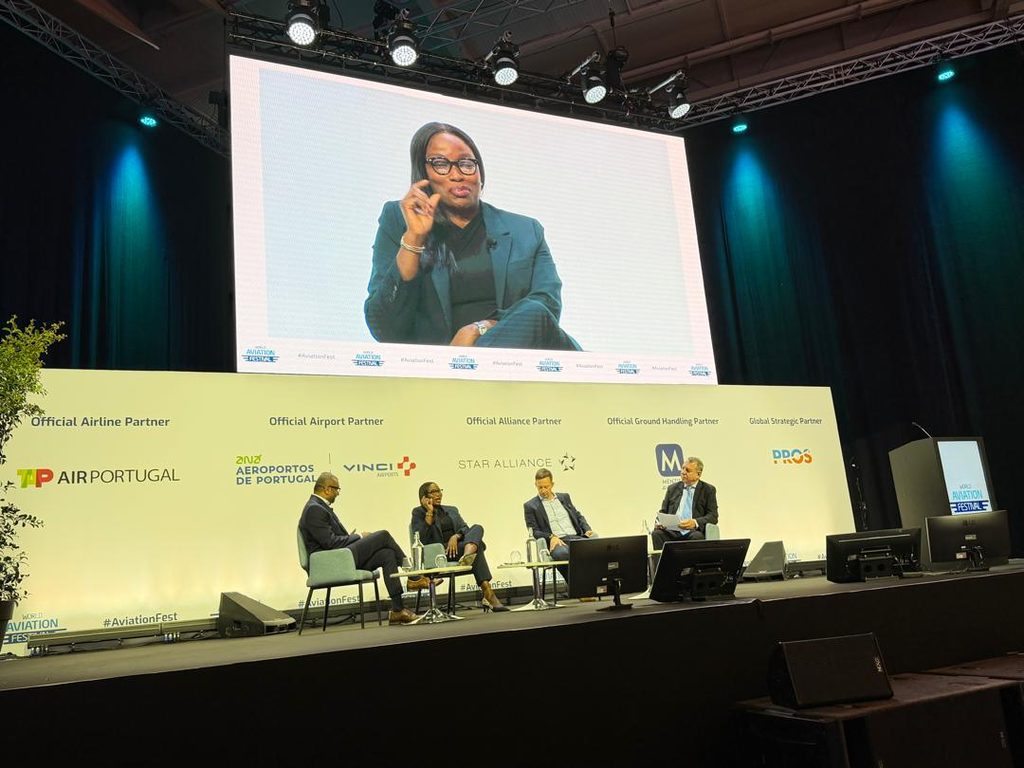
The Managing Director/Chief Executive of the Federal Airports Authority of Nigeria (FAAN), Mrs. Olubunmi Onabanjo-Kuku, disclosed this while speaking at the World Aviation Festival in Lisbon, Portugal, where she participated as a keynote panellist.
The proposed project, being pursued in collaboration with the Federal Government and the Lagos State Government, is expected to connect the airport’s three terminals to the Red Line, making it easier for passengers and other airport users to travel between the airport and different parts of Lagos.
Speaking during a panel session themed “Defining the Airport of the Future: Technology, Partnerships and People”, Kuku said efforts were underway to finalise the financial arrangements for the project.
“We are actually working on completing the financing of the capital structure for that project”, she said.
Explaining the expected benefits, the FAAN chief said the rail connection would provide quick access between the city and the airport, with five stops within the airport premises.
“What it does is it allows us to connect the city very quickly to the airport with five stops within our airport. It connects our terminals and links our cargo terminals to the last stop. So, it’s a collaboration with the state government and the federal government as well”, she said.
The project forms part of broader efforts to modernise MMIA and improve the movement of passengers and cargo through integrated transport infrastructure.
MMIA Modernisation Targets Passenger Experience
Beyond the proposed rail connection, Kuku outlined ongoing plans to transform the Murtala Muhammed International Airport terminal into a more efficient, passenger-friendly facility equipped with modern technology and improved infrastructure.
She noted that MMIA had not undergone a major infrastructure upgrade since it was built, despite handling the largest share of air passenger traffic in Nigeria.
According to her, Lagos accounts for approximately 68 per cent of the country’s total air traffic, followed by Abuja and Kano, with the three airports collectively handling about 80 per cent of passenger movements.
The concentration of traffic at these airports, she explained, makes investment prioritisation essential, particularly as FAAN is also responsible for maintaining and improving facilities across other airports in the country.
“The MMIA has had no major infrastructure upgrade since it was built. We have just embarked on that upgrade, and I’ll speak about what we’re doing. But that particular airport accounts for 68 per cent of all of my traffic in Nigeria. It’s followed by Abuja Airport, which, I think, handles about three million passengers, and then Kano”, she said.
She added that FAAN must balance the demands of the busiest airports with the need to maintain infrastructure at other facilities under its management and support.
Safety Drives Airport Investment Priorities
Kuku said FAAN’s investment strategy was guided by three key considerations, beginning with safety, which she described as fundamental to airport operations.
She explained that a significant proportion of the agency’s investments had focused on airside infrastructure to ensure safe and reliable operations.
According to her, FAAN had concentrated on rehabilitating major airports, particularly the country’s primary international gateways, over the past three years.
“For me, it’s been threefold. The first is a very clear criterion that focuses on safety, so you will see that a lot of our investments largely focus on some of the airside activities because that’s what we need to have our basic operations running and functional. In the last three years, we focused on rehabilitating our major airports and the primary international airports”, she said.
Nigeria’s six international airports are located in Lagos, Abuja, Port Harcourt, Kano, Enugu and Maiduguri.
Kuku said rehabilitation works included runway improvements, complete resurfacing of runway extensions where feasible, and the installation of improved airfield lighting systems at two of the airports.
She stressed that safety considerations must remain central to decisions on airport infrastructure, even as the government and aviation agencies seek to improve passenger experience and operational efficiency.
Describing air transport as more than a means of moving people from one destination to another, she said the sector also plays a critical role in economic development and national connectivity.
“In Nigeria, we see air transport not just as a mode of transportation, but also as economic viability and support. Air transport has also become one of our safest means of travel. What that means is we need to be able to balance very carefully the sorts of investments and the priorities that we make in those investments”, she said.
Terminal 1 to Undergo Major Internal Overhaul
As part of the MMIA modernisation programme, FAAN is undertaking a comprehensive overhaul of Terminal 1, with emphasis on improving passenger movement and upgrading essential facilities rather than expanding the terminal’s physical size.
Kuku explained that the project would involve a complete internal revamp, including changes to the terminal layout, immigration and customs areas, passenger processing counters, technology and other supporting infrastructure.
“For Lagos specifically, being the flagship airport, Terminal 1 is actually being completely gutted. We’re not expanding Terminal 1, but we’re making it a lot more efficient”, she said.
She added that the redesign would make the terminal more convenient for travellers by improving the arrangement of immigration and customs facilities and reviewing the number and positioning of service counters.
“What that means is that we’re changing the layout with immigration and customs, the number of counters that you have, making it a lot more passenger-friendly, ensuring that we have modernised technology and infrastructure that makes travel easier for passengers”, the FAAN managing director explained.
The rail project and terminal overhaul represent complementary aspects of the broader effort to improve airportl I’ll w b operations at MMIA: while the terminal upgrade is intended to enhance the experience within the airport, the proposed rail link is expected to strengthen access to and from the facility.
If realised, the rail connection would provide an additional public transport option for airport passengers, workers and cargo operators, while reinforcing the integration of aviation with urban mass transit in Lagos.