



… Nigeria’s scheduled airline capacity jumps 37.4% as Onabanjo-Kuku calls for next-generation airports
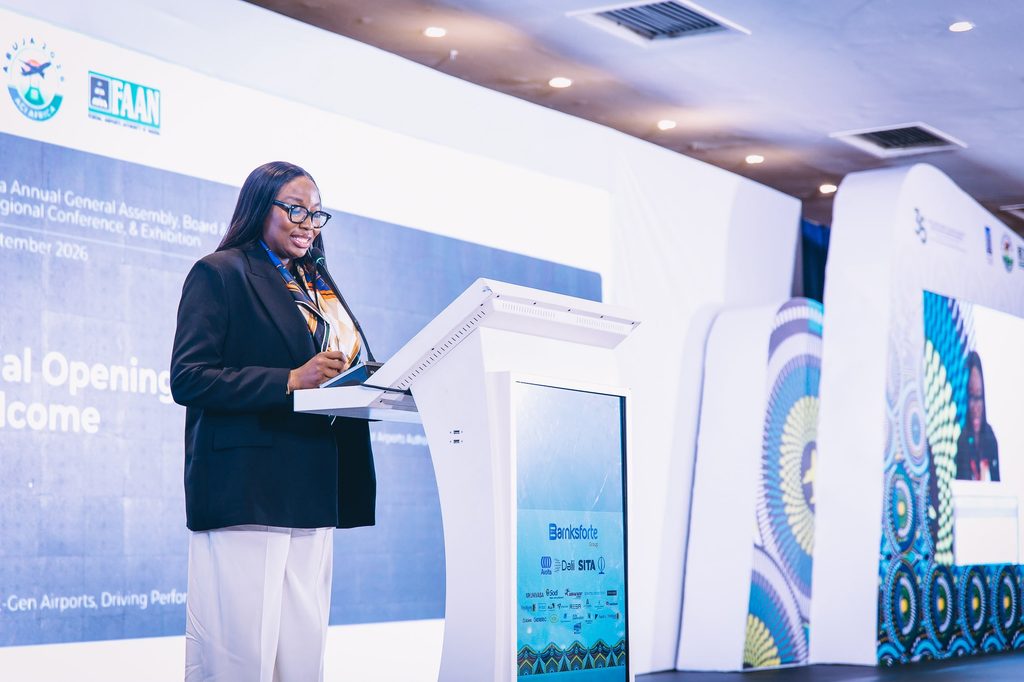
Africa’s rapid aviation growth is exposing a widening gap between rising passenger demand and the infrastructure, systems and investment needed to sustain the sector, Managing Director/Chief Executive of the Federal Airports Authority of Nigeria (FAAN), Mrs. Olubunmi Onabanjo-Kuku, has said.
Onabanjo-Kuku, who is also Vice President of Airports Council International Africa (ACI-Africa), raised the concern while welcoming delegates to the ACI Africa Regional Conference & Exhibition 2026 at the Continental Hotel, Abuja.
Speaking on the theme, “Next-Gen Airports: Driving Performance and Resilience”, she said the continent was experiencing strong aviation growth, but warned that the momentum must be
by deliberate investment in airport infrastructure, technology, human capital and commercial development.
According to data cited by the FAAN chief executive, African airlines recorded a 6.4 per cent year-on-year increase in international passenger demand in July 2026, even as global international demand declined by 0.1 per cent during the same period.
She said Africa’s overall passenger demand also grew by 5.2 per cent, second only to Latin America and the Caribbean and well ahead of the global average growth of 0.2 per cent.
“This continent is on the move”, Onabanjo-Kuku said, stressing that the figures represented more than passenger numbers, as they reflected increased economic activity, family connections, access to healthcare and expanding opportunities.

Nigeria posts fastest capacity growth
Nigeria, she said, was firmly part of the growth story, with the country’s aviation market now ranking fourth-largest in Africa.
More than 18.8 million domestic and international passengers were recorded in Nigeria in 2025, representing an 11.9 per cent year-on-year increase.
She said OAG data showed that Nigeria’s total scheduled airline capacity reached 1.19 million seats in September 2026, representing a 37.4 per cent increase over the same period last year; the fastest growth among Africa’s top 10 aviation markets.
The growth, she said, was being supported by currency reforms, new aircraft leasing arrangements and growing confidence among international carriers seeking to operate in Nigeria.
The Murtala Muhammed International Airport, Lagos, also recorded a 24.1 per cent increase in scheduled seat capacity in September, the fastest growth among Africa’s 10 largest airports, she said.
Onabanjo-Kuku noted that the oldest terminal at the Lagos airport was currently undergoing rehabilitation and upgrading, even as passenger and airline activity continued to expand.
She added that several airlines had resumed operations in Nigeria since the current Minister of Aviation and Aerospace Development assumed office, with more expected to follow.
Growth exposes structural weaknesses
But the FAAN boss cautioned that passenger and capacity growth alone could not guarantee a sustainable aviation industry.
Africa, she noted, accounts for only about 1 per cent of global air traffic despite having 18 per cent of the world’s population, while load factors remain below global averages and the financial viability of African airlines remains fragile.
“In Nigeria alone, with a population exceeding 220 million, we record approximately 19.5 million passengers annually across 28 airports”, she said.
She identified funding constraints, infrastructure gaps, high operating costs, fragmented connectivity and the pressure to keep charges low while providing world-class facilities as some of the challenges that must be addressed.
“This is not a reason for despair; it is a reason for deliberate, strategic action”, she said.
According to her, the challenge for African aviation is therefore not simply to accommodate growth, but to build airports and aviation systems capable of sustaining it.
FAAN pushes transformation agenda
Onabanjo-Kuku said FAAN’s transformation journey since 2023 provided evidence that meaningful improvements could be achieved even under difficult conditions.
She said the authority had prioritised safety and capacity through runway rehabilitation, terminal upgrades and improvements to airfield lighting, while maintaining airport operations.
FAAN had also established a Passenger Experience Hub to make speed, predictability, comfort and human assistance more central to airport operations.
“We recognise that airports are not merely infrastructure – they are experiences”, she said.
On digital transformation, she said FAAN was deploying fast check-in systems, automated e-passport gates, enhanced security systems and passenger-data analytics to improve airport operations.
She also disclosed that FAAN achieved dual ISO 9001:2015 and ISO 14001:2015 certifications in January 2026, describing the achievement as part of the authority’s commitment to quality management, environmental responsibility and continual improvement.
On human capital development, she said more than 3,500 personnel had been trained and certified through ICAO and ACI programmes.
The authority, she added, had also retooled its Directorate of Cargo Development Services as part of efforts to position Nigerian airports as logistics platforms for regional and international trade.
Five priorities for Africa’s next-generation airports
Looking ahead, Onabanjo-Kuku said African airports must move beyond incremental improvements and begin preparing for the airport ecosystem of 2036.
She identified five priorities: financial sustainability, intelligent infrastructure, operational resilience, human capital and strategic partnerships.

On financial sustainability, she called for airports to diversify their revenue beyond aeronautical charges and develop commercial ecosystems around logistics parks, hospitality, retail, data-driven services and airport-city development.
She said intelligent infrastructure should go beyond terminal construction to include predictive maintenance, reliable power, digital operational systems and data analytics.
On operational resilience, she said airports must develop redundancy, agility, intelligence and disciplined communication systems capable of reducing the time between disruption and an effective response.
She also stressed the importance of a competent and continuously learning workforce, saying human capital remained critical because technology could become obsolete and infrastructure could depreciate.
On partnerships, she said governments alone could not provide the investment, technology and expertise required to transform African airports.
“We must build commercially viable partnerships with private investors, airlines, technology providers, logistics companies, and development finance institutions”, she said.
Call for stronger investment framework
The FAAN chief executive called on African governments to establish predictable, long-term and commercially disciplined frameworks for airport infrastructure investment.
She urged governments to give airport leaders clear mandates, predictable resources and sufficient room to manage commercially, while maintaining accountability for measurable results.
Onabanjo-Kuku also called on development partners and financial institutions to recognise airports as strategic economic infrastructure deserving sustained investment.
For airport leaders, she advocated prioritising projects that protect safety, build capacity, generate revenue and strengthen resilience, noting that not every desirable project could be funded at once.
She pointed to the African Continental Free Trade Area (AfCFTA) and the Single African Air Transport Market (SAATM) as important frameworks for expanding regional connectivity and liberalising air travel.
She also identified Africa’s young, digitally oriented workforce as an opportunity for the continent to leapfrog legacy systems.
“Every passenger who passes through our airports carries dreams, responsibilities, and aspirations. We must build airports worthy of that trust”, she said.
The FAAN boss said African aviation had demonstrated resilience through currency crises, health emergencies, supply-chain disruptions and geopolitical uncertainty, adding that the sector had continued to adapt, innovate and grow.
She expressed optimism that the Abuja conference would enable aviation stakeholders across the continent to share experiences, strengthen partnerships and develop a common direction for the next generation of African airports.