



By Daphne Uduneje
The rapid advancement of artificial intelligence (AI) is forcing a rethink of conventional advertising models, as industry players grapple with the implications of technologies capable of generating content, analysing consumer behaviour and influencing how brands engage their audiences.
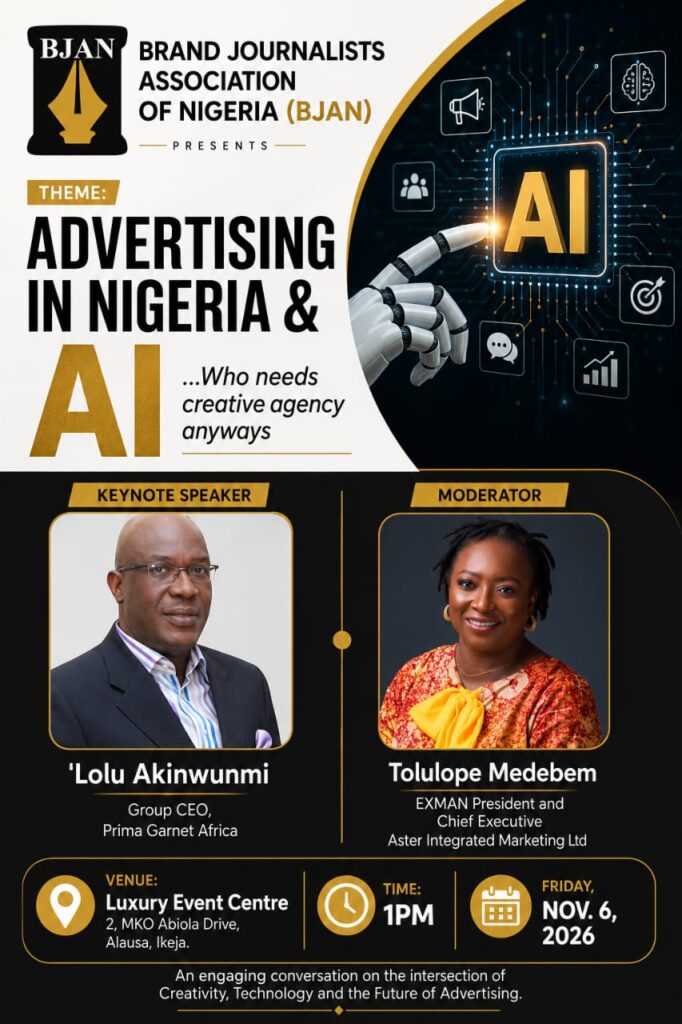
Against this backdrop, advertising and marketing professionals, brand managers, media executives and other industry stakeholders are expected to converge in Lagos on November 6, 2026, for a conference organised by the Brand Journalists Association of Nigeria (BJAN).
The conference, scheduled to hold at the Luxury Event Centre, Alausa, Ikeja, Lagos, is themed “Advertising in Nigeria and AI: Who Needs Creative Agency?”
The theme reflects a growing debate within the global advertising industry over the changing relevance of traditional creative agencies at a time when generative AI and other emerging technologies are rapidly altering the creative and strategic processes behind advertising campaigns.
Beyond the novelty surrounding AI, the conference is expected to examine its practical implications for Nigeria’s advertising and marketing communications ecosystem, particularly the extent to which the technology could complement, disrupt or redefine established industry structures.
AI-powered platforms are increasingly being deployed to generate written content, images, videos and campaign concepts, while also providing data-driven insights into consumer preferences and behaviour. These capabilities are reshaping the way businesses approach content development, campaign planning and audience engagement.
For advertising agencies and creative professionals, however, the development presents a more fundamental question: where does technology end and human creativity begin?
While AI can process large volumes of data and generate creative outputs at speed, questions remain about its ability to replicate the strategic judgement, cultural understanding, emotional intelligence and human connection required to build enduring brands.
It is against this backdrop that BJAN’s conference is expected to explore whether artificial intelligence could eventually displace the traditional creative agency or, alternatively, become an important tool for enabling agencies and practitioners to deliver more effective and data-driven solutions.
The conference will feature perspectives from some of the country’s leading advertising, marketing and communications professionals.
‘Lolu Akinwunmi, Group Chief Executive Officer of Prima Garnet Africa and a prominent figure in Nigeria’s advertising and marketing communications industry, is expected to deliver the keynote address.
Bethel Obioma, Head of Communication at Sahara Group, will serve as Guest Speaker.
Their presentations are expected to examine the changing advertising landscape and provide perspectives on how industry practitioners and businesses can respond to the opportunities created by AI without losing sight of creativity, strategic thinking and the human element of brand communication.
A panel session will further interrogate issues arising from the keynote presentation, bringing together professionals with experience across advertising, technology, marketing and brand management.
Among those expected to participate are Dr. Seyi Akindeinde, Chief Executive Officer of Hyperspace; George Onukwo, Chief Executive Officer of TBWA/Concept; and Sandra Amachree, Head of Marketing Communications at Nigerian Breweries.
The panel will be moderated by Tolulope Medebem, President of the Experiential Marketers Association of Nigeria (EXMA) and Chief Executive Officer of Aster Integrated Marketing Limited.
Beyond the Technology
For BJAN, the conference is intended to go beyond a discussion of AI as an emerging technology to examine its broader implications for professionals, agencies and businesses operating within Nigeria’s advertising and marketing communications ecosystem.
Speaking on the event, BJAN Chairman, Daniel Obi, said the conference would provide stakeholders with an opportunity to gain a clearer understanding of the transformation taking place across the industry.
Obi said the focus would be on how professionals and organisations could strategically respond to the changes driven by AI rather than simply examining the technology itself.
“As technology continues to influence the way brands communicate with consumers, industry stakeholders need to understand the implications of AI for the future of advertising in Nigeria,” he said.
The conference comes at a time when businesses are under increasing pressure to deliver more personalised and measurable communication while controlling costs and responding more quickly to changing consumer behaviour.
For advertising agencies, this could translate into a shift in the nature of their value proposition, with technology increasingly taking over some production-intensive functions while strategic planning, creativity, brand stewardship and human insight remain central to their relevance.
The implication is that the debate may no longer be simply about whether AI will replace creative agencies, but about how agencies themselves will evolve as the technology becomes more deeply integrated into the advertising value chain.
For Nigeria’s advertising industry, which serves a diverse market shaped by different cultures, languages, income levels and consumer behaviours, the ability to combine technological capability with local insight could ultimately determine how effectively businesses harness AI.
BJAN’s November conference is therefore positioned as a forum for stakeholders to examine these emerging realities and consider what the next phase of advertising practice could look like in Nigeria.
As the industry moves from experimentation with AI towards wider adoption, the conversation is increasingly shifting from whether brands and agencies should use the technology to how they can use it responsibly and strategically without compromising creativity, trust and human connection.
For BJAN, the gathering is also an opportunity to strengthen its role in facilitating informed conversations around developments shaping Nigeria’s brand, media and marketing communications landscape.